
B. ‘Fürst Trubetzskoi’
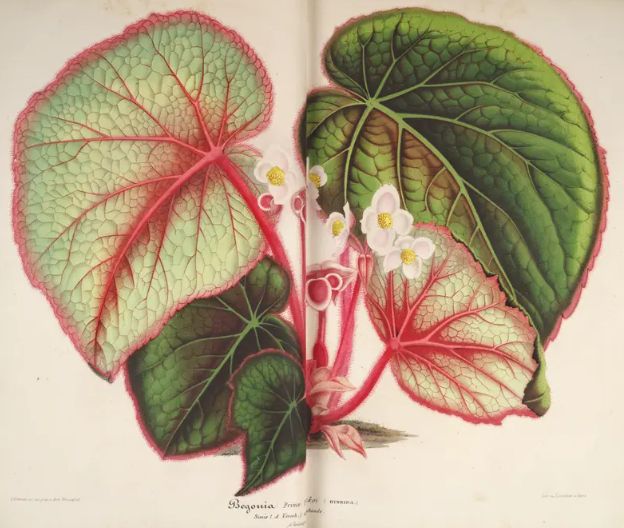
In the well-known Verschaffelt nursery in Ghent, hybrids with Begonia splendida and xanthina have been produced that have beautiful leaf patterns and deserve our highest recommendation. These are Begonia Madam Wagener, Fürst Trubetzskoi, and Miranda. The first two are illustrated in Illustration Horticole.
Rather large leaves, which in outward appearance sometimes more resemble those of B. splendida and, like them, are drawn to a short point, appearing weakly lobed and coarsely toothed, but sometimes also possess the shape more of B. xanthina. Verschaffelt has given an illustration in his horticultural illustration (in volume 5, on plate 158), which, beautiful as it is, by no means gives too much detail. It is a pity that the leaves lose their beautiful markings with age.
The markings of B. annulata are most clearly visible in this hybrid. Around the insertion of the leaf segment, the color is blackish-green and extends sometimes somewhat striped to the middle. Later it becomes lighter and spreads even further Next comes a ring around the leaf's surface, initially a vibrant green and quite broad, but later becoming lighter and narrower. Near the edge, this ring is replaced by a blackish-green coloration that also extends around the entire leaf. The outermost canthus itself is a beautiful brownish-red and is further adorned with brownish-red bristles. On the underside, where the veins and their main branches are very prominent, the ring in the center is quite pale, almost yellowish-green, while elsewhere the coloration is a magnificent brownish-red. While the surface is densely covered with short, bristle-like hairs, these are only found on the veins and larger veins of the underside. The leaf and flower stalks are red in themselves, but also densely covered with lighter bristles. The same is true only for B. splendida, while the red coloration of the aforementioned parts seems more pronounced in B. annulata. The beautifully rose-colored or fiery-red nematodes have a brittle base, are fleshy, and soon retract. The large cymes bear somewhat fleshy petals, of which the two or three outer petals on the somewhat conical back are flesh-colored, while the inner petals appear faintly rose-red. They therefore bear a much closer resemblance to those of B. splendida than to those of B. annulata or even B. xanthina. The hairs themselves are not as stiff.
- Classification: Cultivar
- Plant Type: Rhizomatous
- Origin: Europe, Belgium
- Originator: Verschaffelt
- Date of Origin: 1858
Begonia Community Hub
Share a Growing Update
Loading community updates...