


B. baronii
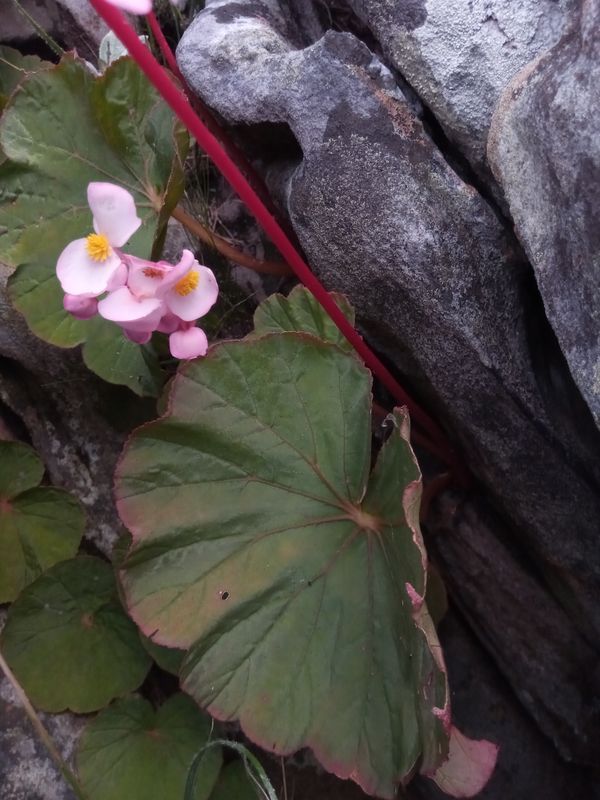
A caulescent plant, with a gnarled rhizome, often embedded in the cracks of the rocks, with erect, robust, crassulescent or sublignous stems, annual? glabrous, up to 40 to 60 cm in height and 8-9 mm in diameter, reddish, bearing 4-6 leaves. Leaves a petiole 5-30 cm long, reddish, glabrous; subcordiform green lamina, slightly asymmetrical, sometimes almost pelte, attenuate or distinctly rounded at the apex, ± scallop at base, 8-19 X 8-21 cm, with smooth margins, glabrous on both sides; 5-7 main veins starting from the base, marked on finely projecting below. Stipules triangular, 10-30 x 10-15 mm glabrous. Biparous, axillary, bi- or unisexual cymes; 10-20 white, pink or bright pink flowers; robust peduncle up to 50 cm in height and 5-8 mm in diameter; obovate bracts ± acute at apex, glabrous, 3-5 X 2-4 mm; pedicel grele, 8-15 mm long. MALE flowers have 2 rounded suborbicular tepals 12-14 x 10-14 mm, glabrous. Stamens 15 approx., Fasciculates, very short threads; elongated antheres, 2-4 mm long. Flowers FEMALE has 4 ever green, obovate tepals, attenuate towards the base, 8-12 x 6-8 mm. Ovary oblong 6-13 mm; styles 3, generally bifid, sometimes development of a short stigmatized median band; stigma in spiral blade. Capsule red, oblong, 18-25 x 6-10 mm, has 3 wings, the widest 10-15 mm (sometimes 25-30, Baron 4353, K) the two small 1-3 mm (6-8 mm); long lasting styles. - Pl. 21, p. 71. According to Perrier de la Bathie, if there are two inflorescences per foot, the superior, that is to say the youngest, will bear FEMALE flowers and the lower, the oldest, FEMALE flowers with some MALE flowers blooming after the flowers. But if the foot bears only one inflorescence, it is composed only of flowers MALE. The leaves would be edible.
Pests Diseases
- Classification: Species
- Plant Type: Shrub-like
- Botanical Section: Nerviplacentaria
- Origin: Africa, Madagascar
- Originator: Baker
- Date of Origin: 1887
Begonia Community Hub
Share a Growing Update
Loading community updates...