


B. tsaratananensis
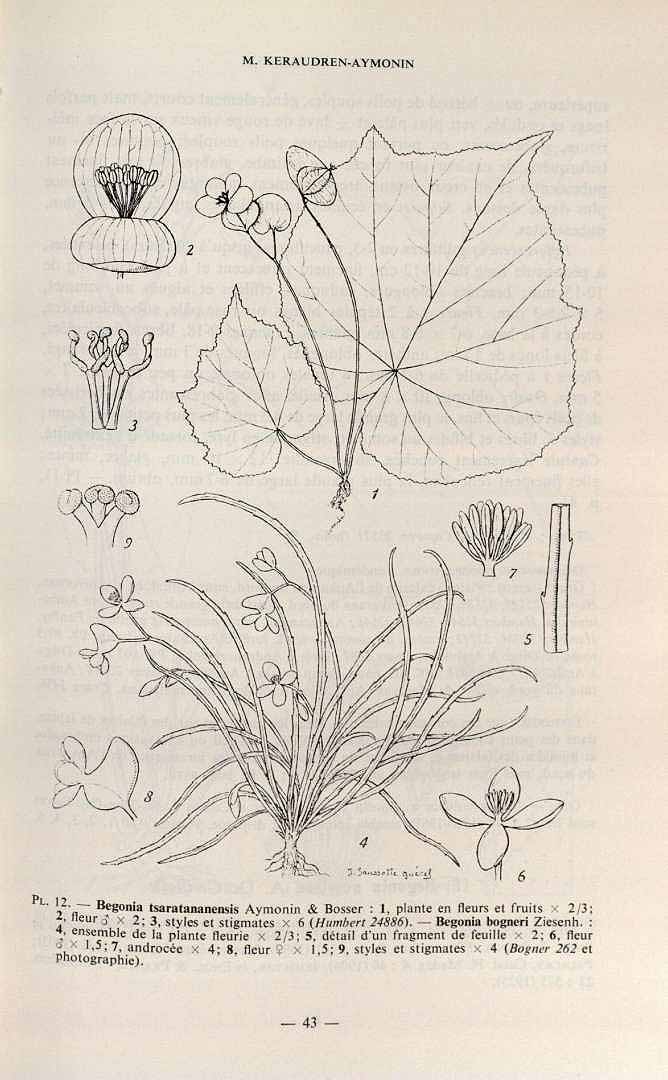
Planta perennis, acaulis, rhizomato 3-4 mm crasso. Foliis rotundatis, tridentatis vel trilobatis, apice aculeatis, basi late cordatis, lamina viride supeme, inferne rubro-vinaceo, marginibus denticulatis, 7-15 cm longa, 5,5-11 cm lata. Inflorescentia 2-3 floribus albolacteis; florum MALE tepala 2,8-12X 10-12 mm, staminibus liberis 10-18; florum FEMALE tepala 4, similiter, stylis 3 liberis, stigmatibus torsivis. Capsula trialata, ala maxima 10 mm lata. Acaule plant; rhizome thick, 3-4 mm in diameter, (thickening per place in small tubercle) (Humbert), bracts lanceolate, thin, uninerved, 3-4 mm long. Leaves 1 (-2); blade 7-15 X 5, 5-11 cm membranous on the dry (dark green velvet above, ± vinous red by beaches below) (Humbert), broadly rounded general outline, acuminum at the top, often more or less strongly trident or trilobe in its upper half, deeply cordiform and subsymetrical at the base, with rounded basal lobes, overlapping or not, with margins finely dentees; upper surface of the leaf blade spiculiform whitish or slightly russet, sparse and regularly distributed, the lower surface glabrous or has few hairs on the base of the veins. Stipule membranous, brownish, acuminate, 4-8 mm long. Inflorescences 1-2 shorter or equal to the leaf, usually bisexual, 2-3 flowers (1-2 MALE flowers, 1 FEMALE flower); peduncle 3-16 cm long glabrous; ovale-subacute, brownish, membranous, 5 (-7) nerves, deciduous, 7-8 mm long; pedicel 0.5-1 cm long. MALE flowers have 2 suborbicular tepals, 8-12 X 10-12 mm, pure white, a few strings at the base. Stamens 10-18 with free fillets, 1-1.5 mm long; oblong antheres, 1-1.5 mm long. FEMALE flowers a. 4 tepals largely elliptical, suborbicular, 8-10 x 7-10 mm, pure white. Ovary oblong, about 1 cm long, glabrous, has 3 slightly decurrent wings on the pedicel; 3 styles, free, bifid at the top, twisted stigma. Capsule slightly inclined, oblong, 10 x 7 mm (without wings), with small rounded wings, 3-5 mm wide, with large triangular-obtuse wing, 10 mm wide. Seeds not seen. - PL 12 p. 43. This species has only been harvested twice in the Mangindrano region on the first slopes of Tsaratanana. By some characters, like the MALE flower has 10-18 stamens, it approaches the B. ankaranensis Humbert, but it differs on the one hand by the characters of leaves, on the other hand by the ecological requirements. It differs from B. nossibea, from which it is derived, by its generally thicker habit, the indentation of margins of the leaves, and the absence of large scales at the level of the underground apparatus.
Pests Diseases
- Classification: Species
- Plant Type: Rhizomatous
- Botanical Section: Quadrilobaria
- Origin: Africa, Madagascar
- Originator: Aymonin & Bosser, Fl. Madagascar
- Date of Origin: 1983
Begonia Community Hub
Share a Growing Update
Loading community updates...