


B. teuscheri
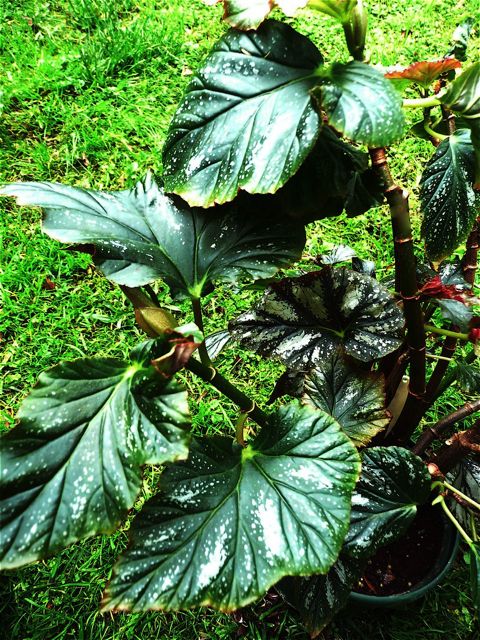
The Begonia teuscheri, introduced by M. Linden two years ago from the Dutch Indies, is yet another proof to add to those which demonstrate the polymorphism of the species of this genus. Immediately after its importation, the plant began to bloom and to bear fruit and the first seedlings that came from it showed notable differences with the mother plant, in form and the coloring of the foliage. The leaf at the bottom of our board is close to the type; it is equally cordiform acute or heteromeric, and on its dark green surface are detached many rounded white spots almost equidistant. The texture of this leaf is thick, fleshy, brittle; a purple border, equally dentate with saw-like teeth, surrounds it completely. The under leaf is uniformly red blood purple. One of the two varieties that we represent is already substantially modified in the maculae of the upper page, which are continuous and widened in the inter-ribs, and the marginal teeth have a tendency to become lobes, a tendency which has been accentuated in the clearly lobed variety that we see on the right. Here, the serratiform border has taken on greater importance, and on the black green surface of the surface, white patches are little developed are raised by a grayish sand which replaces the typical points observed in the species. Now that the foliage Begonias have entered a new way by hybridizing the varieties of B. Rex with discolor, we have no doubt that B. teuscheri is helping to improve these new breeds; so beautiful, so rustic, so precious for floriculture. Ed. Andre. 1879.
Pests Diseases
- Classification: Species
- Plant Type: Shrub-like
- Botanical Section: Latistigma
- Origin: Asia, Indonesia (Netherland Indies)
- Originator: Linden ex André, Ill. Hort.
- Date of Origin: 1879
Begonia Community Hub
Share a Growing Update
Loading community updates...