
B. semperflorens
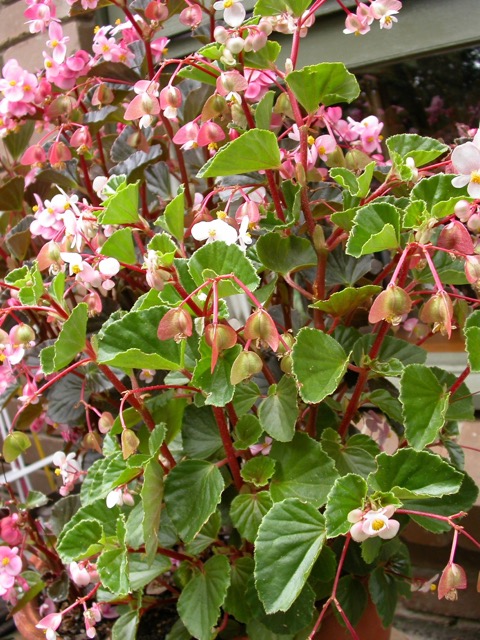
Mollers Deutsche Gartner-Zeitung. Erfurt, v. 15 (1900) http://www.biodiversitylibrary.org/item/194341 Group begonias of the Semperflorens class, with special reference to the novelty Begonia semperflorens atropurpurea nana fl. Pl. "Bijou des Jardins". - By Wilhelm Thurmer, Handelsgartner in Diemitz-Halle a. S. The abundance of emerging novelties of the semperflorens variety Begonia, is almost scary. From all countries, from all regions, they come with the pervading names in all languages: English and German, French and Latin, some quite apt, others less and much synonymous. Very aptly the name 'Bijou des Jardins' (also known as the English novelty 'Little Gem') which is always blooming, low and stocky, with the cute stuffed bright red flowers, also named as a 'Carpet Konigin'. Really, a 'gem' and not least radiant in this class. The Company Pape & Bergmann in Quedlinburg has the largest stock of this valuable novelty for seed breeding, because it is true from seed. Also, if 'Bijou des Jardins' is not quite as low as the real 'carpet kingdoms', it achieves a height of 15-20 cm. The dark-glittering foliage resembles that of the 'Carpet Queen', and the filled blossoms are a delightful sight. It is as valuable as pot as well as group plant equally valuable because the cultivation and culture are very simple and easy. The picture above shows a plant from the cultures of Pape & Bergmann in Quedlinburg. 'Zulukonig' is not brand new, but all the more valuable, in fact an improvement of 'Vernon', because if you can call the color tone of foliage in ‘Vernon’ glossy brown-red, 'Zulukonig' is blackish to purple. The multiplication, however, this variety must be done by cuttings, because it does not come true from seed. The same applies to 'Erfordia', some consider Begonia semperflorens gracilis to be far superior because it is a seed crop. According to the opinion of various begonia experts, whose opinion I had occasion to hear, the Pfizer's reintroduction of 'Anna Regina' has this in common with gracilis. Two other lovely group begonias are the Lemoine breeds 'Corbeille de Feu' and 'Abondance', the former with rose-reds, the latter with bright red blooms. The leaves in these two are similar to the foliage of the begonia fuchsioides or, more correctly, that of the B. scandens, while the leaves of 'Fleur de Neige' are more like the leaves of the Begonia metallica, on a very reduced scale. The flowers of these latter are pale pink, almost white. The planting of the carpet beds with Semperflorens begonias. – by J. Glunicke, in company: Sattler & Bethge, A.-G. in Quedlinburg. Not so long ago, most carpet beds were planted with variegated leaves, especially with Alternanthera, but since the genus of Semperflorens begonias have been cultivated Rug-planting has taken a turn. Indeed, the semperflorens begonias seem to initiate a whole new direction in the planting of flower parterres and carpet beds. The illustration on page 506 shows carpet beds of the company planted with semperflorens begonias Sattler & Bethge. I can say that the planting our parterre seldom was admired so much as this summer. I want to outline the planting of the flower beds. The foremost, about 6 m in diameter holding large round bed in points the middle a Dracaena indivisa, surrounded by Iresine lindeni, which are further enclosed in a circular planting of Begonia semperflorens 'Corbeille de Feu', connecting to a wavy planted circle of Begonia semperflorens gracilis. To this circle are added semicircular points, comprised of masses of Begonia semperflorens 'Vulkan', edged with B. semperflorens nana compacta 'Vernon'. The background of the bed is Antennaria tomentosa, from which the small circles planted with Begonia semperflorens 'Zulukonig' and bordered with B. semperflorens nana compacta 'Vernon' effectively stand out. The whole bed is with Begonia semperflorens nana compacta 'Vernon' enclosed as a conclusion. Similar to this, the rearmost round bed, planted in a star shape, is made in such a way that the individual points of the star alternate with Begonia 'Corbeille de Feu' and 'Abondance', but otherwise resembles the planting of the first bed. The middle of the arabesques are Pelargonium zonal 'Mac Mahon' with bronze colored foliage and the side parts of Begonia semperflorens 'Fleur de Neige' and bordered by Iresine Wallisi. The Fountain is from B. semperflorens 'Fleur de Neige', Montbretia and Santolina tomentosa. The lateral front beds have a background from Antennaria tomentosa, from the arabesque, Made from Alternanthera amoena spectabilis nana compacta grandifolia, despite the long name, completely especially stand out. As a mount serves Alternanthera purpurea grandifolia. To complete the picture of the parterre to explain, I still mention that the beds on the side wall left with Nicotiana sylvestris, a very spare novelty, before the orange scarlet begonia hybrida 'Mammuth' and Montbretia, are planted. The back end of the whole Parterres forms about 30 m long and 2 - 3 · m wide foliage plants group, those with Nicotiana sylvestris, N. colossea and N. colossea fol. variegatis, Gunnera manicata, Echinops giganteus, Solanum robustum and S. atropurpureum and Ricinus zanzibariensis, concluding with a number of Montbretia and Fuchsia 'Golden Fleece' was planted. Let me now follow a short description of each Begonia semperflorens variety. 'Corbeille de Feu' has fiery coral flowers, shiny metallic lanceolate leaves and grows to a height of about 20 cm. 'Abondance' with equally beautiful foliage and magnificent pink flowers is about 20-25 cm high, so slightly higher than the former. Both varieties are French breeding and are unique in their kind, flowering immensely, even in winter, but can only be propagated by cuttings, which they produce easily. l do not know of a begonia that was more suitable for group planting and that had a more beautiful foliage than 'Vulkan' which is also of French descent and resembles the old 'Vernon', but is not as high as that and has larger and much more luminous, dark fiery red flowers with golden yellow stamens. The foliage takes on a brown-red color in full sun. This strain is true from seed. Begonia semperflorens Gracilis has magnificent pink flowers and a beautiful green foliage; quickly fills with flowers, and true from seed. 'Vernon nana compacta' has small fiery red flowers, and dark foliage in sunny plantings. Under these circumstances it is 8-10 cm high. 'Zulukonig', a well-known very valuable breed with deep black-red foliage, only from cuttings, reaches 15-20 cm high. Seed can be grown but seed plants are taller according to my observations and do not have a black-red, but a lighter foliage, are not always as good. Seed plants flowers the same as cutting grown, but in ‘Zulukonig's’ case, the deep black-red foliage has a much greater importance than the flowers. 'Fleur de Neige' is again, as the name implies, of French origin. It has pure white flowers, which have a pink glow on the underside, and has kidney-shaped leaves, is very rich in flowers and is very much too recommend. The following recommended varieties were not used for the planting of our parterres. Begonia semperflorens nana compacta alba of very low growth with pure white flowers and very strong flowering. True from seed. 'Anna Regina' has beautiful pink flowers that are a bit bigger than those of the gracilis. Begonia semperflorens atropurpurea fl. pl. 'Little Gem' brings already filled purple flowers, has a black and red foliage and a spherical, compact growth, but with only 50% true from seeds, so for the time being, the propagation of cuttings is preferable. Finally, I want to commemorate a begonia, not to the Semperflorens variety, but a Tuber-begonias, and this is Begonia hybrida gigantea 'mammoth'. Unfortunately, there is of this splendid variety until now only one color, scarlet red. 'Mammuth' is characterized by a particularly lush growth and already veined tight foliage. The very large firm, fleshy flowers are freed from finger-thick stems the great nature of 'Mammuth' is more and more used for group planting. Like all tuberous begonias, this one loves a partially shaded spot to develop quite well. I hereby conclude my brief essay, and I hope that it will contribute to a further spread of the very beautiful and grateful Semper florets begonias, whose exceptionally rich and long-lasting florets make them very suitable for group planting. Besides, still comes the consideration that Semperflorens begonias are of great diversity in their stature, as well as in their deciduous and blood color, so they offer the largest selection change for the most varied groupings.; Curtis's botanical magazine, v. 56 = ser. 2, v. 3 (1829) B. semperflorens: Description Stem erect, rather thick, terete, fleshy, glabrous, reddish green, scarcely, if at all branched. Leaves alternate, remote, plane, ovato-rotundate, obtuse at the base, rarely a little cordate, unequal, apiculate, the margins minutely serrated, more or less ciliated at the margin, color pale green, the surface particularly smooth and free from hairiness. Petiole long, reddish, channeled, at the base are two large, ovato-oblong. Deciduous, ciliated brownish stipules. Peduncles axillary and terminal. Male flowers with two large rounded, and two small, oblong or linear, rose colored petals. Female flowers with five small unequal petals, of the same color. Capsule greenish brown, membranous, reticulated, having three very unequal wings; two small, narrow, and equal in breadth throughout, while the third forms a large, triangular, very projecting and obtuse membrane. The nearest ally of this species is, probably; the B. spathulata of Willdenow; but there, the leaves are far more concave, not apiculated, the stipules are larger, and the larger wing is acute. The present species was sent to the Liverpool Botanic Garden, by Charles Chamberlayne, Esq. from Brazil, and flowered in October 1828. I have seen this species cultivated in gardens in Britain, under the names of B. setaria and B. sellovii.; The Garden, v. 36 1889 WINTER-FLOWERING BEGONIAS. In common with the tuberous-rooted section of Begonias that flower during the summer months, those that bloom throughout the autumn and winter have within the last few years become far more popular than hitherto, and some of our most prominent hybridists have devoted their attention to the production of new varieties. Among the older winter-flowering Begonias may be mentioned several of the original species and hybrids raised therefrom, most of which are of a shrubby character, while recently the curious peltate leaved B. socotrana and some of the tuberous-rooted class have been successfully employed in the production of the newer hybrids. Of varieties not springing from either of these two just mentioned and of original species valuable for their winter blooming qualities may be especially mentioned. B. semperflorens The specific name of this species is well bestowed, for it will bloom continuously throughout the year. In the form most commonly met with the flowers are white tinged with pink, but in some the blooms are pure white, while in others they are very richly tinted. One of the very best of winter-flowering Begonias is usually classed as a variety of B. semperflorens under the cumbersome name of B. semperflorens gigantea carminea. It is of continental origin, and when first sent out was announced as a cross between B. lynchiana (Roezli) and B. semperflorens. The entire plant, however, bears a far greater resemblance to B. lynchiana than to its other reputed parent, the principal difference being that it is less liable to run up naked at the base than B. which often does not break out freely even if pinched back during its earlier stages, while B. semperflorens gigantea carminea can be induced to form quite a bushy plant. Other kinds known as gigantea rosea and B. gigantea elegans seem to differ but little from that above described.; Wiener illustrirte Garten-Zeitung, jahr. 18, 1893 B. semperflorens Lk. & Otto: Every gardener and garden friend knows the high value of single species of the genus Begonia, of which not only the beautiful bulbous ones alone, but also some shrubby species are used with special preference during the summer months because of their infinite bloodshed. The perfection of flower and habit in tuberous begonias is well known, but less so are the different forms of the old well-known B. semperflorens Lk. & Otto, which does not match with B. semperflorens Hooker (Beg. Hookeri Sweet) and may be confused. When our B. semperflorens was actually introduced into the European garden is indefinite, but it is certain that quite a few forms of this plant are cultivated today, which are essential both by the coloring of the foliage, as well as by the size and color of the bloom different. The plant has smooth stems, a low shrubby growth. The leaves are oblique, round, almost heart-shaped, notched, the sides of the petals are oblong, the flowers numerous, white, standing in forked umbels. From this plant the two varieties var. Rosea and var. Coccinea were first brought up, which differ from each other by the large, bright pink and scarlet flowers. Later, Mr. Hofgartner Pettera in Gmunden succeeded in raising a variety with dark red leaves from seeds, which, is known as B. semperflorens foliis atropurpureus, however, it did not have the same distribution as the today diversely famed and cultivated B. semperflorens var. Vernon, although they almost are identical and show only a small difference in the color of the flowers. The dwarf forms of the B. semperflorens, namely the var. Compacta nana with a bright red flower, which was marketed by the French breeder Delaux, and the var. Compacta alba, which was raised from seed in Germany, showed particular advantages for group planting. These two varieties are about 12 cm. high and covered with flowers almost all year round. B. semperflorens everblooming quality was universally acknowledged, excellent breeders of this plant seized and sought to produce new hybrid forms, for which, above all, the B. Schmidtiana, as a crossing parent was used. This species, also from Brazil and introduced by the company Haage & Schmidt, is also known as a flowering plant thanks to which the leaves are obliquely heart-shaped, brown-brown, red on the back and hairy on both sides. The flowers are white and sepals a light rose. The pretty structure and the bloom-richness made this species particularly suitable for crosses. From this cross the well-known B. florida incomparabilis, which was released by Haage & Schmidt with that of Ed. Andre named B. pictaviensis and the Bruant common B. bruanti could all be identical. Even the same quantity of B. massiliensis brought to the market by Deleuil comes from the same plants, and therefore shows no particular deviations from the one mentioned earlier. A significant innovation was achieved by the well-known French breeder Lemoine, who crossed the old B. semperflorens with the B. roezlii, thereby raising a hybrid possessing the stocky, multi-branched habit of the mother plant, but also the powerful leaves and the larger flowers the second variety shows. Because of this characteristic, it was named Lemoine B. semperflorens gigantea. Apart from this striking variety Lemoine brought up two other hybrids, similar to B. semperflorens gigantea, but differ in their growth and bloom color. These are B. semperflorens elegans and B. semperflorens sieberiana. The former has a fiery rose tone, in the half-open state almost fiery flowers, while the latter shows a very delicate pink, and is also distinguished by a somewhat higher growth. Very interesting, however, is the variety B. rosea floribunda, which was allegedly brought up by the commercial gardener E. Cappe in Vesinet in France by crossing the B. pictaviensis with the dark-leaved var. Vernon. This low-growing plant reaches a height of 20-25 cm., Its smooth stems are bright red, bear small, almost round, glossy, short-serrated leaves and numerous rose-violet flowers which protrude freely above the foliage. The beauty of this plant is undeniable and a coincidence it may have been that it was created in three places almost simultaneously, B. Schmidti hybr. Rosea and B. versaillensis are commercially traded under the already cited. These hybrids were joined in the past years by a novelty developed by Mr. Hofgartner Pfister in Gaibach, which arose from a crossing of the B. semperflorens with the B. Froebelii and named by the breeder B. semperflorens Vera. The individual flowers of this plant, which is depicted in the 'Moller'sche Gartenzeitung', have a diameter of 3 ½ cm., Stand together in loose umbels of 6-10. They are white under glass and take on a light rose nuance outdoors. This beautiful flowering Begonia, planted on a group, makes a wonderful effect, since every plant carries so much bloom that the small B. schmidti-like leaves hardly are visible. For the sake of completeness, we just want to mention that in recent times Mr. Mapp Neustadt of Aisch was concerned with the improvement of B. semperflorens, and indeed bred some varieties which, according to the reports, deserve all attention. But also in the local municipal reserve garden, a new variety has been raised in this year, which remains completely low, easily grown and blooming. The blooms of this sort are lively pink, but relatively small, which is hardly noticeable with such a huge quantity of flowers. For the next year the Firm Haage & Schmidt spreads a new hybrid, called B. Erfordia, and appears in the figure 80. Again, this novelty is a hybrid of B. Schimdtii, but with the B. Vernon, and is called the most beautiful breed. The construction of the plant corresponds to that of the B. Schmidtii, as well as the position of the flowers, which are delicately carmin rose colored. The foliage, on the other hand, and the dark bronzed undertones are reminiscent of B. Vernon. Like all other varieties of B. semperflorens, this novelty is also suitable for group planting and remains completely constant from seeds, which is not the case in all varieties. The cultivation of this plant species is very easy with its varieties and hybrids and offers no difficulty.
Pests Diseases
- Classification: Species
- Plant Type: Semperflorens
- Botanical Section: Ephemera
- Originator: Link & Otto, Icon. Pl. Rar.
- Date of Origin: 1828
Begonia Community Hub
Share a Growing Update
Loading community updates...