


B. ‘Ryoku-Ha’
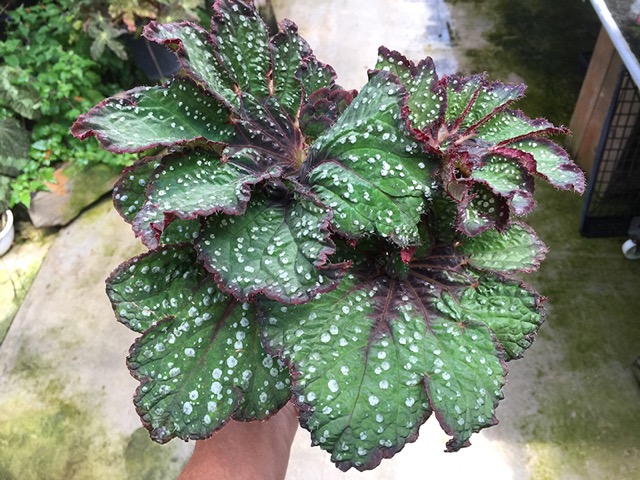
A group of researchers at the Isotope Laboratory in Tokyo, Japan created two Rex cultivars using Begonia ‘Winter Queen’ as the test subject. These were B. ‘Gin-Sei’ (sometimes spelled B. 'Ginsei') and B. ‘Ryoku-Ha’ (sometimes spelled B. 'Ryokuha').
Parent variety: Winter Queen (provided by Tokyo Metropolitan Agricultural Experiment Station)
Irradiation treatment: Using a 60Co-A radiation source, adventitious buds of leaf cuttings were irradiated at a dose rate of 200 R/hr, with a total dose of 10 kR (1966).
Branch mutation confirmed by pruning, separation by division, and stabilization confirmed in 1970.
The leaves are green with a few small, distinct silvery-white spots. The central area where the veins converge and the leaf margins are dark reddish-brown. Under weak light, they are dark green; under strong light, they become yellowish-green, and the reddish-brown areas turn dark red. They show clear damage from ozone.
The leaves are large, 25-30 cm long and 20-25 cm wide, with a nearly circular, distorted heart shape and deeply notched edges, and a wavy, spiraling leaf shape.
- Classification: Cultivar
- Plant Type: Rex Cultorum
- Origin: Asia, Japan
- Originator: Naoki Matsubara, Koji Shigematsu & Hirokatsu Suda
- Date of Origin: 1968
Begonia Community Hub
Share a Growing Update
Loading community updates...