


B. platanifolia
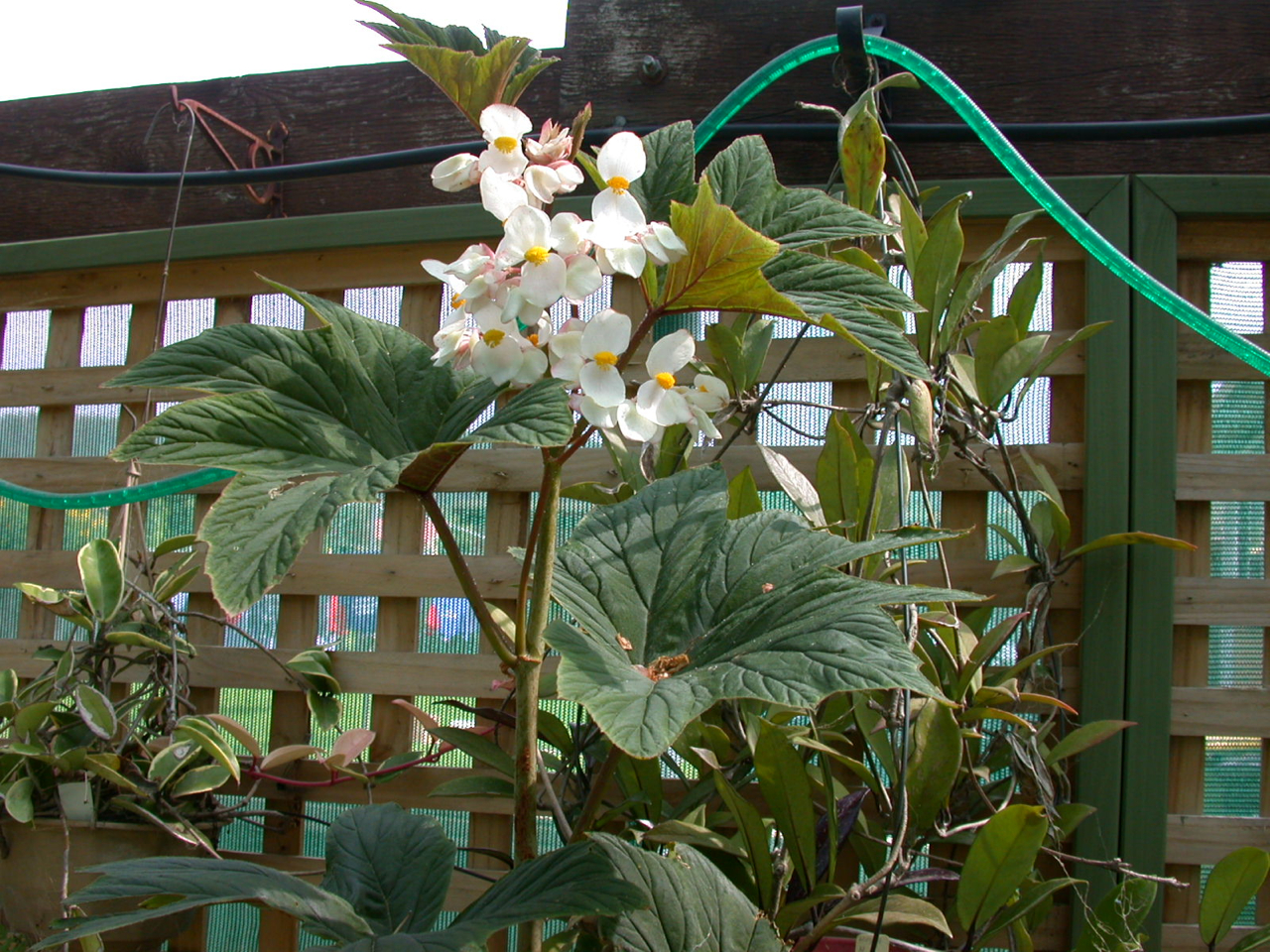
fruticosa; folii ubaequaliter reniformibus lobatis serrulato-denticulatis utrinque hispidis subtu purpurascentibus, lobis acutis, stipulis ovatis acutis rigidis demum marce centibus. Masc. Cal. o. Cor. polypetala, petalis plerumque 4, inaequalibus. Faem. Cal. o. Cor. petalis 4-9, plerumque inaequalibus. Styli tres, bifidi. Caps. triquetra, alata, trilocularis, polysperma. We received this large and handsome species at Edinburgh from Berlin in I834, but the plants did not grow vigorously, nor flower, till this year, when our increased accommodation at the Botanic Garden enabled us to give them greater stove heat. Description: Stem erect robust of rapid growth, (in our specimen, from two and a half to five and a half feet high) round joints slightly swollen and marked with a ring, from whence the stipule fell, glabrous, showing little disposition to develop branches unless the top be injured. Leaves (8-10 inches across at their greatest diameter alternate, petiolate, reniform, nearly equal at the bases, lobed, hispid on both sides, dark green above, paler and becoming purplish below, especially on the ribs, which are strong and prominent; lobes acute, contorted, serrulatodenticulate, and in the interstices between the teeth crenulate and ciliated; petioles (two to three inches long) nearly round, slightly flattened above, erect ; stipules opposite, intrafoliaceous, ovate, acute, involute, herbaceous, rigid, marcescent. Cymes axillary, on peduncles as long as the petioles, dichotomous, always bearing a flower in the cleft, fully developed only after the leaf, from the axil of which it springs, drops off; branches slightly hairy, spreading like a fan. Male flowers (there are no others on the only two specimens which have yet flowered with us) tetrapetalous, nearly white, very large (two inches across); petals very unequal, the larger rotundato-ovate, the smaller spathulatolinear. Stamens numerous, connected only at the base: filament slender: connective thick, and clavate: anther-cells small, on the outside of the connective, and towards its edges. Graham.; Paxton's magazine of botany, v. 3, 1837 B. platanifolia: This plant is rarely met with in a flowering state in the stoves of this country; a circumstance probably accounting for its limited circulation, and the more frequent occurrence of other species of this genus, most of which are in many particulars inferior, and very distinct from the one we have figured. Our drawing was made, about the latter end of last autumn, from a sample kindly furnished by our friend Mr. Cameron, of the Birmingham Botanical Garden, with whom it flowered beautifully in the stove. It is a plant frequently seen in the collections about Paris, and is stated to flower freely in that country. The plants of this genus partake somewhat of a succulent habit, and are generally more admired from the circumstance of the neatness of their leaves, which are oblique at the base, than from any trace of beauty in their flowers; they grow with little difficulty among other plants in a bark stove, potted in a light loamy rich soil. Propagation is readily effected by cuttings, planted in sand in heat; or by seeds (if such can be obtained), is a ready mode of increasing them. The generic name is given in honor of Michael Begon, whose exertions in the promotion of Botany were conspicuous in the seventeenth century. It is a native of Brazil, introduced from the Berlin Gardens by the late R. Barclay, Esq., in the autumn of 1829.
- Classification: Species
- Plant Type: Cane-like - Superba
- Botanical Section: Latistigma
- Origin: America, Brazil
- Originator: Schott in Sprengel, Syst. Veg.
- Date of Origin: 1827
Begonia Community Hub
Share a Growing Update
Loading community updates...