


B. picta
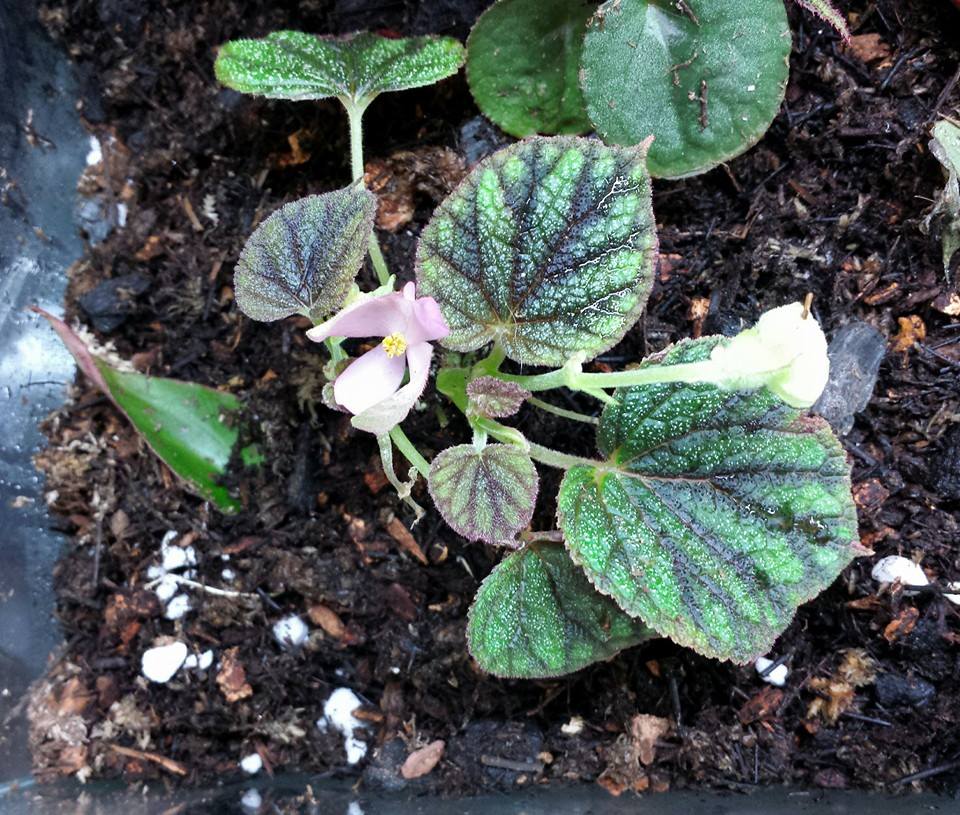
Curtis's botanical magazine, v. 57 = ser. 2, v. 4, 1830 B. picta. Description: Stem about a span high, arising from a tuberous root., herbaceous, scarcely branched., reddish, lightly downy, green above. Leaves cordate, inequilateral, with a deep sinus at the base, and two large, rounded lobes, rather obtuse, the margins unequally and doubly serrated, downy beneath, here the nerves are very prominent, hispid above, at the margin and axil of the nerves stained with dark purple. Peduncle from the axils of the leaves, and longer than them, reddish below, green above, bearing one or several flowers, often it a trichotomous umbel. Flowers large, rose colored, very handsome, drooping before and after expansion, especially the female. Male flower of four spreading petals, two large, roundish-cordate, hispid, with short, red hairs at the back, two inner ones obovate. Female flower of five petals, three outer ones rotundato-ovate, hispid at the back, two inner smaller, and obovate. Germen inferior, turbinate, downy, with three wings, one large and two smaller ones, each dilated upwards into an obtuse angle. Stamens., Style, and Pistil as in most of the Genus. Neither my own figure in Exotic Flora, nor that of Loddiges in the Botanical Cabinet, does justice to the beauty of this plant, and the size of its flowers. This is often the case with plants that are figured when they first bloom after their introduction to this country; afterwards they become stronger, and flower in much greater perfection. B. picta was first figured by Sir James E. Smith in the Exotic Botany. It is a native of Nepal; but probably of the warmer parts: for it seems to flourish best with the heat of our stove, in which situation, the plant from which our figure and description were taken flowered in the Glasgow Botanic Garden, in the month of September 1829. B. picta. Of a neat dwarfish habit, compact, six to twelve inches high. The leaves are obliquely heart-shaped, having a velvety surface of a dark olive-green, finely relieved by a band of light-green encircling the broad central dark-green space, and having a very conspicuous rich crimson marginal belt. The underside has a broad central blotch of crimson, corresponding with the position of the dark green of the upper surface. The Magazine of horticulture, botany, and all useful discoveries and improvements in rural affairs. V.26 1860 pg 131-136.
- Classification: Species
- Plant Type: Tuberous
- Botanical Section: Diploclinium
- Origin: Asia, Himalayas; Pakistan; NE India; Myanmar
- Originator: J. E. Smith, Exotic. Bot.
- Date of Origin: 1805
Begonia Community Hub
Share a Growing Update
Loading community updates...