


B. nossibea
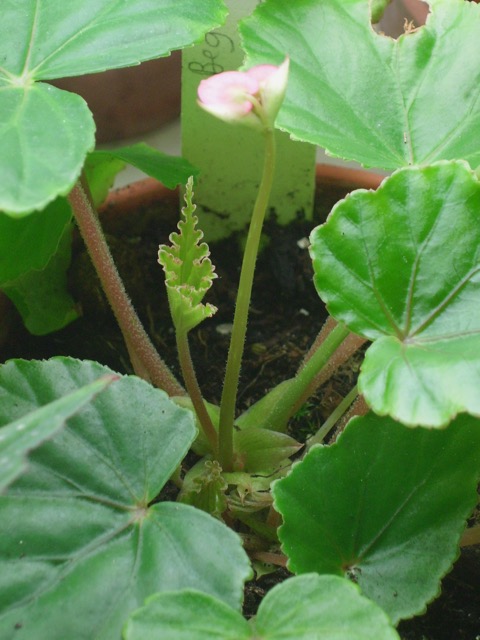
Plant acaule has subterranean rhizome crawling quite thick. Leaves petiole thick, reddish, a little pubescent or glabrous, 7-20 cm long; membranous lamina, 7-9-palmatinerve at base, 6-1 X 6-20 cm ovate, rounded, somewhat oblique, pointed tip at top, rope at base, marbled, dark green and glabrous on the face upper, green with red winey beaches and a little pubescent on the lower face; edges finely dente; ribs finely projecting and ± pubescent on the underside. Leafy, ovate, acute and mucronate at the apex, 8-10 mm long, very tight on the rhizome. Inflorescence pauciflorous, sparsely branched; white flowers or pale pink; common peduncle 12-40 cm long, glabrous; first branches 2 cm long; foliate bracts, 4-5 mm long deciduous; pedicel thick, -15 mm long. MALE flowers has 2 orbicular tepals, 8-9 X 8-10 mm. Stamens approx. 15 to 40, fasciculeses; free nets, 1-1.5 mm long; oblong antheres 2 mm long, yellow. FEMALE flower a. 4 oblong tepals, 8 X 4 mm. Oblong, 12 x 5 mm; styles 3, bifid on their half; stigma rolls up on every branch of the style. Capsule leans horizontally, making almost a right angle with the peduncle, this one about 2 cm long; rounded wings, the largest a little triangular and 6 mm wide, the two small ones 2-3 mm wide, completely surrounding the central part. Seeds small, 0.25-0.3 x 0.12-0.15 mm. - Pl. 13 p. 45.
Pests Diseases
- Classification: Species
- Plant Type: Rhizomatous
- Botanical Section: Quadrilobaria
- Origin: Africa, Madagascar
- Originator: A. de Candolle, Ann. Sci. nat., Bot. ser. 4.
- Date of Origin: 1859
Begonia Community Hub
Share a Growing Update
Loading community updates...