


B. neoperrieri
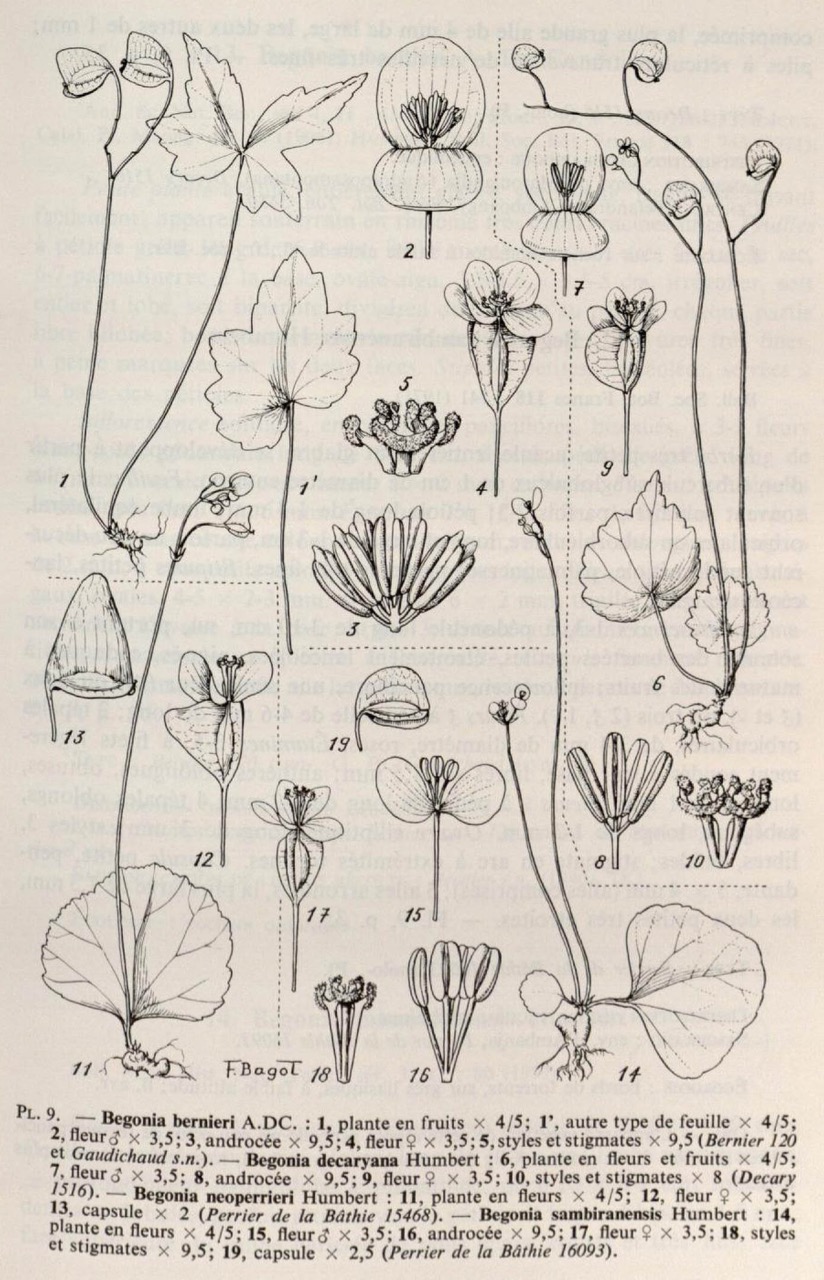
Plants small, acaule, entirely glabrous, with subglobular tubercle 3-4 mm in diameter. Single leaf, petiole 3-15 mm long; thin branches. suborbicular, 5-7-palmatinerve 2-5 x 3-4 cm, truncate at base or deeply cordate, equilateral with finely crenellated margin; bifurcated veins; network of nerves extremely thin. Stipules small lanceolees-acute. Inflorescence single, pauciflorous, bisexual, in bipolar cymes has 2-3 branches; pink flowers; peduncle 4-10 cm long, thick; pedicel of 3-6 mm; subtriangular bracts, 2 mm long. MALE flowers has 2 elliptical tepals of 4-5 x 3-4 mm. Stamens 3-5 with 2 mm long threads slightly welded at their base; oblong antheres, 1 mm long. Flowers FEMALE has 2 tepals, ovate, long and 3-4 mm wide; styles 3 consistent at the base, bifid at the top; Crooked stigma, at the end a little twisted. Capsule oblong, 9-12 x 6-7 mm; large subtriangular wing, 6- mm wide: narrow wings, barely 0.5 mm wide; network of very thin ribs. - Pl. 9, p. 35. The vegetative apparatus of this Begonia recalls that of some dwarf specimens. two leaves (B. rhodesiana Irmscher) related to Begonia princeae Gilg of East African mountain
Pests Diseases
- Classification: Species
- Plant Type: Rhizomatous
- Botanical Section: Quadrilobaria
- Origin: Africa, Madagascar
- Originator: Humbert ex Keraudren-Aymonin & Bosser, Bull. Soc. Bot. France
- Date of Origin: 1973
Begonia Community Hub
Share a Growing Update
Loading community updates...