


B. marojejyensis
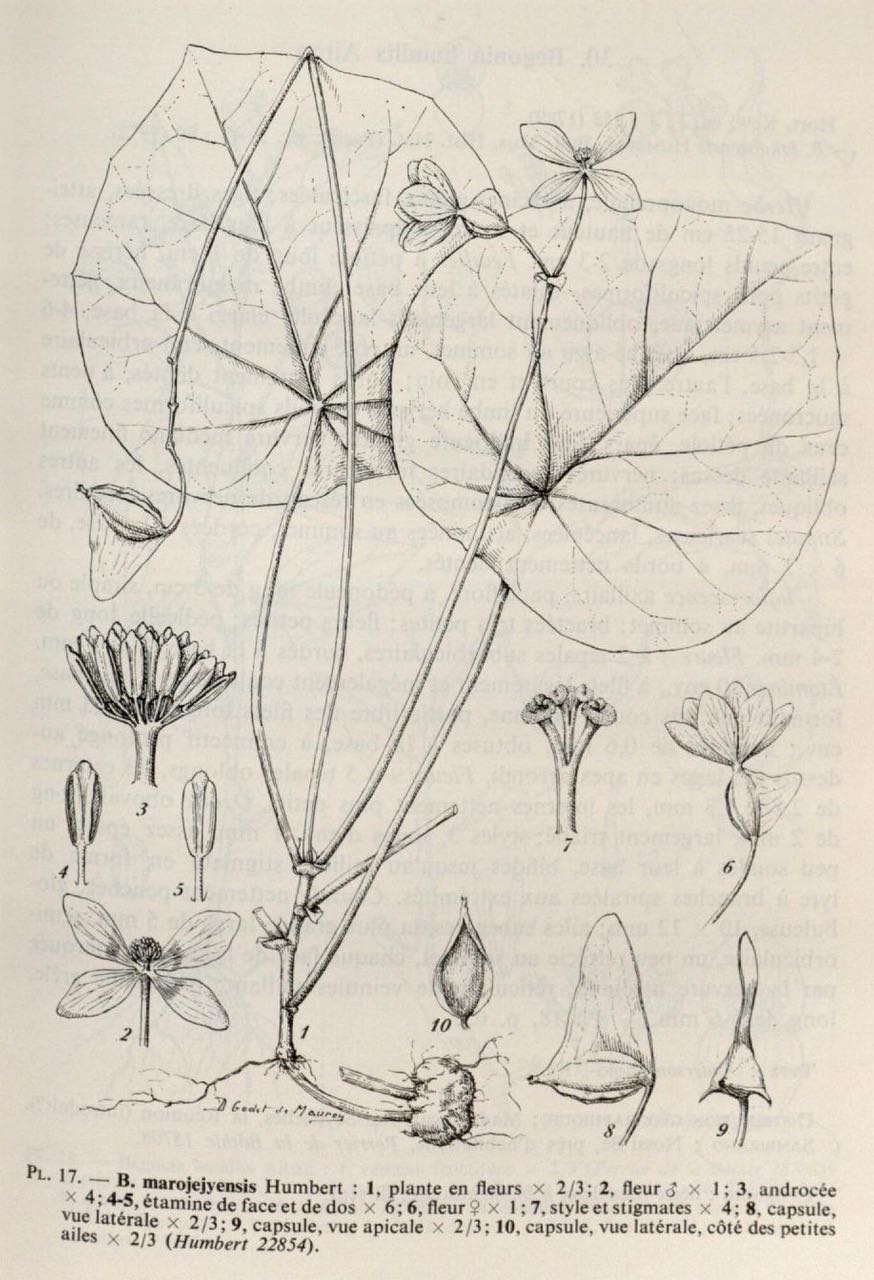
Fleshy plant, entirely hairless, perennial; subterranean rhizomatous tubercle, approx. 2 cm in diameter; stem very short, 5-10 cm long, with short internodes 5-15 mm long. Leaves few, 3-6, fairly close together; stipules subdeltoides, 10-15 mm long; petiole 10-14 cm; blade pelte, very fleshy, suborbicular outline, subacute at the top, long and wide of -10 cm, shiny green marble of darker areas at the veins; margins and upper surface often reddish; entire borders or tiny mucons very open spaces; 7 main veins pelted; secondary veins barely distinct. Inflorescence pauciflorum, 2-4-flowered; peduncle 15-20 cm long; pedicel fairly thin, 1-2 cm long; furnished at its base with a stipuliform obovate-triangular, deciduous bractee. MALE flowers has 4 tepals bright pink, but white base, obovate-obtuse, a little uneven, 12-14 x 5-7 mm. Stamens 20, with nets firstly welded to a 2 mm column and free 1 mm long; oblong antheres, light yellow, 2 mm long. FEMALE flowers has 6 sub-palal tepals, similar to those of flowers; 2 mm long style, trifide; 3 stigmata revolute transversely, forming a thick crown, papillous, open towards the inside. Capsule of 12 x 4 mm (without wings) with 3 angles terminated by 3 unequal wings, the largest of 10-15 mm wide, the other 2 of 1-2 mm. - Pl. 17, p. 61. This Begonia with original leaves also has large flowers (about 30 mm) and is one of the very decorative species of Madagascar and has been preserved for a long time in the Botanical Garden of Tsimbazaza in Antananarivo.
Pests Diseases
- Classification: Species
- Plant Type: Tuberous
- Botanical Section: Erminea
- Origin: Africa, Madagascar
- Originator: Humbert, Mem. Inst. Sci. Madagascar Ser. B, Biol. Veg.
- Date of Origin: 1955
Begonia Community Hub
Share a Growing Update
Loading community updates...