
B. marnieri
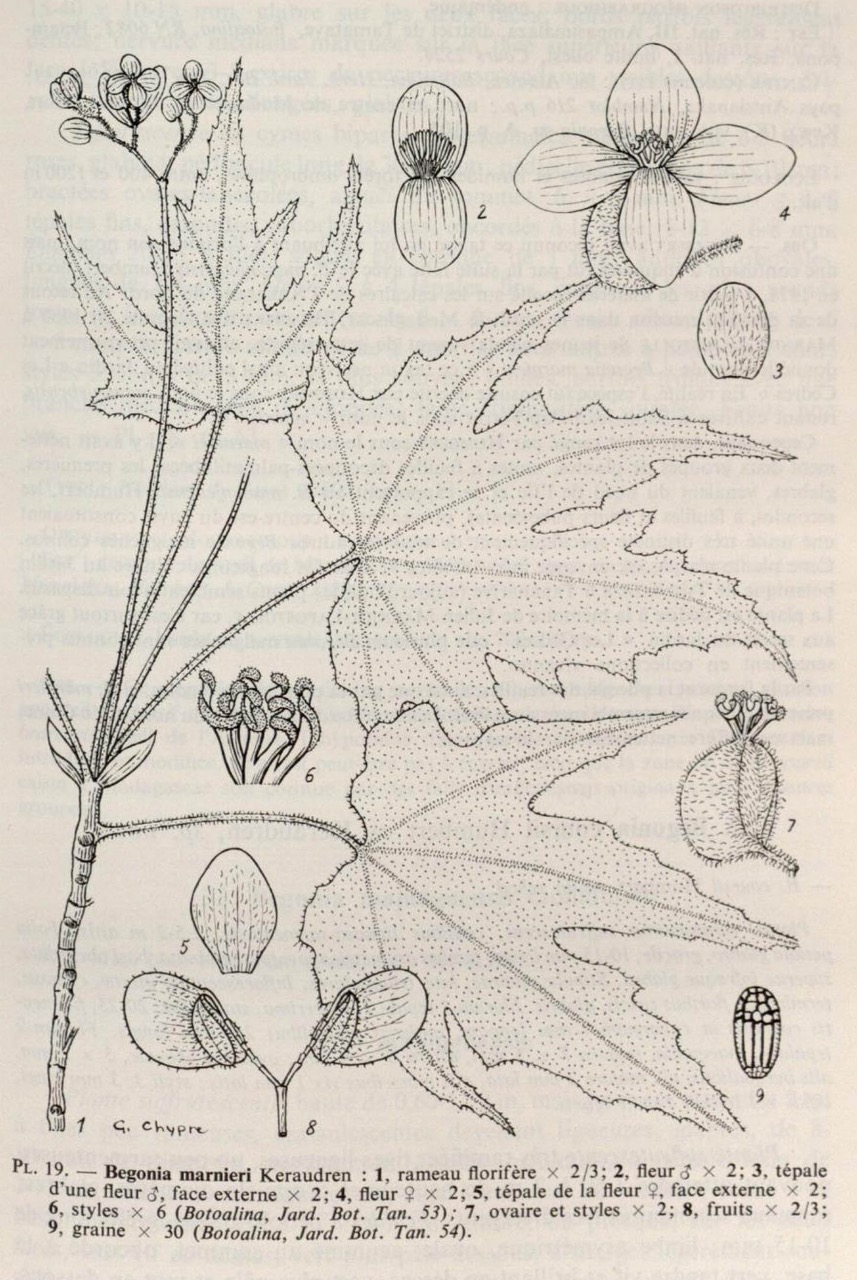
Planta herbacea perennis, radicibus fasciculatis, caulibus erectis 30-100 cm altis, 4-5 mm in diametro, primum pubescentibus. Folia persistentia, petiolo roseoviride 5-15 cm longo dense albis pilis ornato; lamina valde palmatilobata (7-18 x 6-10 cm), ordinatim pilis hispidis ornata, subtus bruneo-viridis praeter nomwnquam venas albidas, inferne rubroviridis ad basim 5-6 palmatinervia, lobis triangularibus, apiculatis, margine ciliato-dentatis. Stipulae manifestae. lnflorescentia pauciflora, bractea fere caduca externe albis pilis ornata, pedunculo 8-20 mm longo, pedicellis gracilibus 5-12 mm longis, pubescentibus. Florum MALE tepala 2, suborbicularia (7-10 X 7-10 mm) interne glabra, externe longis albi pilis ornata. Stamina multa, fasciculata, filamentis liberis 2 mm longis, antheris 2 mm longis. Florum FEMALE tepala 4, obovata (8-10 X 5-6 mm) externe pilosa. Styli 3, biftdi stigmatibus spiralibus. Ovarium viride, 3-alatum, albido-hirtum. Capsula hirta, valde inclinata, pedunculo 10-15 mm, parvis alis ad pedunculum parallelis, ala majore 15 mm Iata. Perennial plant with fasciculate roots; stems 30-100 cm high and 4-5 mm in diameter, pubescent in a young state and then glabrescent. Leaves persistent, with petiole pinkish green, 5-15 cm long, with dense white hairs; blade deeply palmatilobe, 5-6-palmatinerve at base; triangular lobes, elongate, pointed at tip, cilies-dente at edges, 2.5-3 cm wide at base; Leaf 7-18 x 6-10 cm, uniformly dark brownish-green on the upper side, sometimes vein-white on the veins, reddish-green on the lower side, regularly hairs white hairs, rather short, on both sides; ribs finely marked on both sides. Stipules well developed, oblanceolees, pointed at the top, 1-2 cm long. Inflorescence pauciflora; green flowers a little pink or pink-reddish hue of green on the edges; peduncle 8-20 cm, ± pubescent; bracts ± deciduous with white hairs on the outer side; pedicel grele, pubescent 5-12 mm long. MALE flowers have 2 suborbicular tepals, 7-10 X 7-10 mm, glabrous on the inner side, long white hairs on the outer side. Stamens numerous, fasciculates, with free nets, 2 mm long; oval-lengthened antheres, approx. 2 mm long Flower FEMALE has 4 obovate tepals, 8-10 X 5-6 mm, obtuse at the top, hairs on the outer side. Ovary triaile, green, entirely covered with white hirsute hairs, rather long; styles 3, bifid, almost to their base; stigma spiral. Capsule herissée of hairs, very leaning, the small subparallel wings to the peduncle, this one of 10-15 mm; large wing very rounded, 15 mm wide, the small ones of 3-5 mm, narrower. Obovale seeds, 0.35 (0.5) mm long; tegument reticules, has small stitches at the top and has longer stitches at the base. - Pl. 19, p. 65. Humbert had recognized this taxon by giving it its name, but a confluence of labels was subsequently made with the B. mananjebensis Humbert, described in 1971, from material harvested on the limestones of the island. North Ankarana. On his return from his last mission in the north of Madagascar, Humbert entrusted Marnier-Lapostolle with seedlings from this region in 1960, and provisionally gave the name "Begonia marnieri" to this new taxon cultivated in the Garden. (The Cedars or Les Cedres). In fact, the species was later described by Humbert as mananjebensis, remaining cultivated in Saint-Jean-Cap-Ferrat under the name "marnieri". However, in the lot ranged by Humbert under the name "marnieri", there were clearly two groups of plants, all of them cut-palmatilobed; the first, glabrous, came from the north of the island and relate to B. mananjebensis Humbert, the second, with leaves and pubescent flowers, coming from the center-east of the country, constituted a unit quite distinct from all the other Malagasy Begonia known. This plant was not sent to "Cedres", but was long cultivated at the Botanical Garden Tsimbazaza Tananarive (today, the plants seem to have disappeared). By the shape and the pilosite of the leaves, as well as by the pilosite of tepals, the B. marnieri presents some resemblances with the B. laciniata Roxb. from North India and China, but differs markedly in the capsule.
Pests Diseases
- Classification: Species
- Plant Type: Shrub-like
- Botanical Section: Nerviplacentaria
- Origin: Africa, Madagascar
- Originator: M. Keraudren, Fl. Madagascar
- Date of Origin: 1983
Begonia Community Hub
Share a Growing Update
Loading community updates...