


B. androrangensis
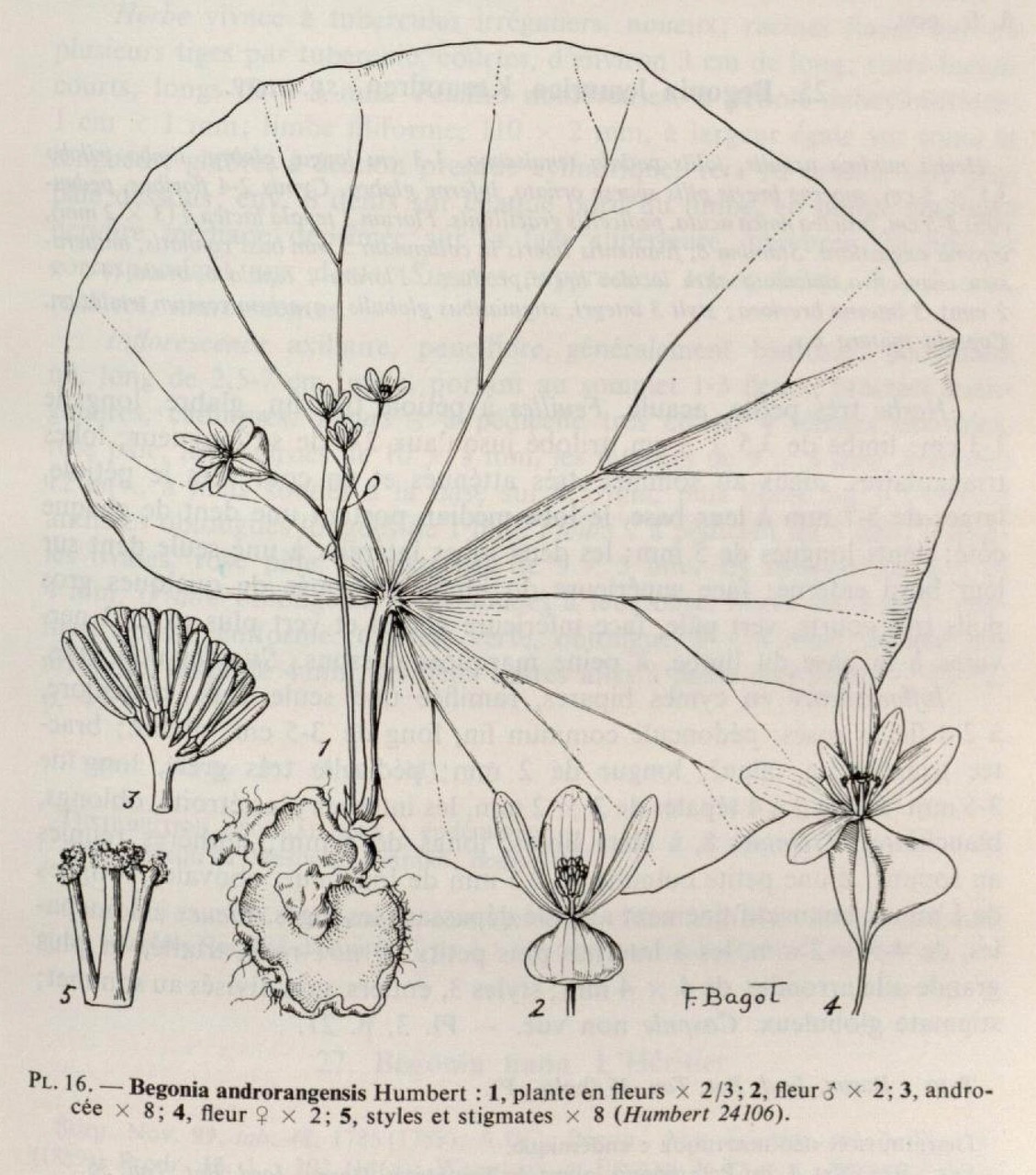
Plant acaule, entirely hairless, with fleshy tuberous rhizome, 1-3 cm wide. Leaves solitary or 2-3, applied on the ground; petiole 1-7 cm long; blade 7-palmatinerve, fleshy, semi-orbicular, somewhat asymmetrical, sometimes slightly pointed and acute at the apex, cord at base, 5.5-11 X 5.5-16 cm, up to 22 x 15 cm in culture, dark green above, green marble or purple hue underneath; bi- or trifurque veins, tertiary network veins, finely anastomose. Stipules lanceolate, acute, 5 mm long. Inflorescences solitary or by 2, in bisexual bipolar cyme of 3-12 MALE flowers and a FEMALE or all flowers; common peduncle thick, 3-8 cm long; Axillary bracts, opposite, lanceolate, small, deciduous. Small, white or pink flowers; pedicel thick, 2-7 mm long. MALE flowers have 4 oblong tepals, 4-5 x 2-2.5 mm, the internal ones are narrower. Stamens ± 12, with threads welded at their base in a column of 0.5 mm, with a somewhat shorter free part, with antheres 1 mm long, obtuse. Flowers FEMALE has 6 tepals, oblong, 3 (often external) 5-6 X 1-1,5mm, 3 larger internal, 7-l0 x l.5-2 mm. Ovary oblong, 7 mm long, a little compressed, triaile; styles 3, 3 mm long, thick consistent at their base; stigma cape, growing thick. Capsule clearly bent, oblong, 15 x 12 mm; large triangular wing, rounded, approx. 8 mm, small wings 2 mm wide; midribs and reticulum of nerves scarcely marks; pedicelled 12 mm long. - P. 16, p. 55.
Pests Diseases
- Classification: Species
- Plant Type: Tuberous
- Botanical Section: Erminea
- Origin: Africa, Madagascar
- Originator: Humbert
- Date of Origin: 1972
Begonia Community Hub
Share a Growing Update
Loading community updates...