


B. leandrii
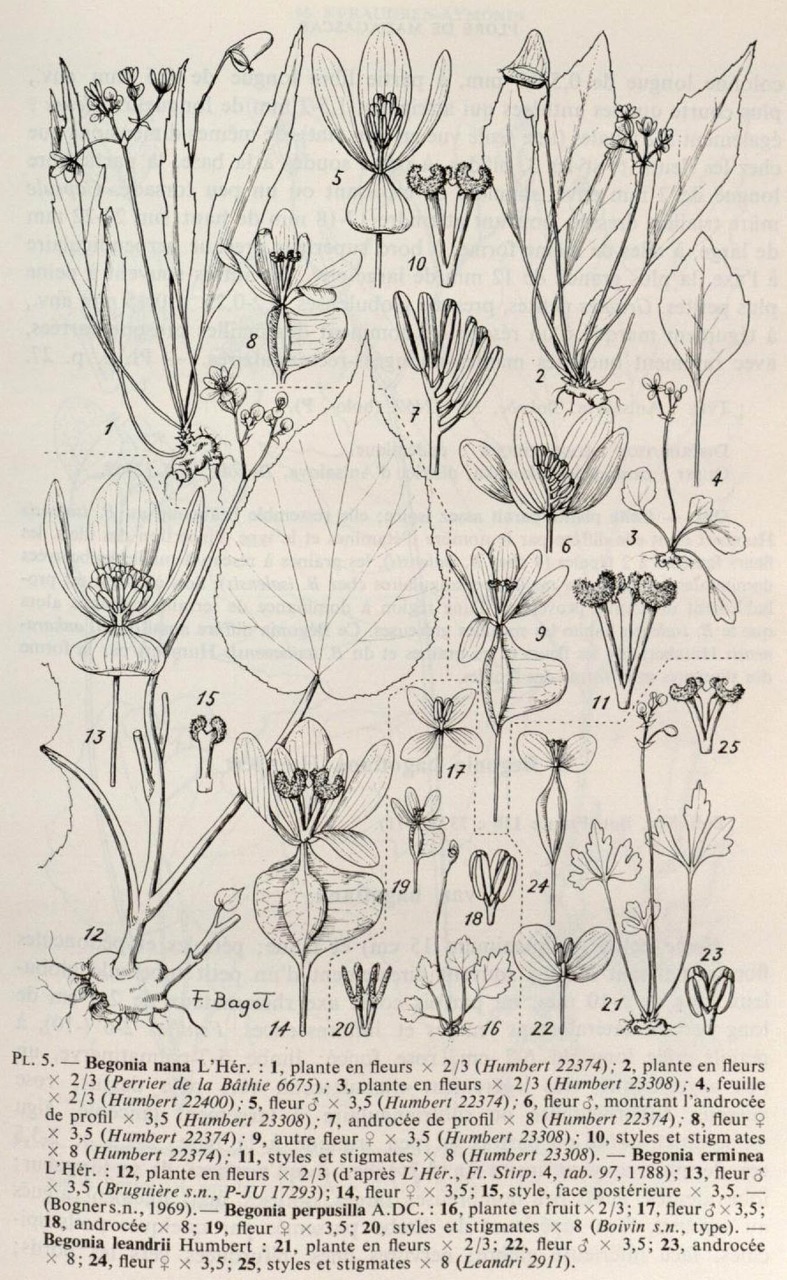
Plant very small, acaule, entirely glabrous with subterranean tuber pisiform of 5 mm of diameter. Leaves 2-3; petiole thick 2-3 cm, pink; very slender trisque blade or 5-palmatiseque, glabrous on both sides long and 2-3 cm wide; obese or petiolule 2-4 mm long; 3-5-lobule lobes; edges 1-2 fine teeth terminated by a spike hair; median vein of the lobes barely marked on both sides. Scaly specimens, lanceolate very sharp, 1 mm long tight on the tuber. Axillary inflorescence almost always solitary, in cymes pauciflorate bisexual of 2-9 white or pink-white flowers; peduncle 5-7 cm long; small bracts 0.5 mm long; thick pedicel 2 mm long. MALE flower has 2 suborbicular tepals, long and wide of 2 5-3 mm. Stamens 2-4 with threads welded to the base in one column; oblong antheres, subsessile on the column, 0.8 mm long, obtuse at base and at apex. FEMALE flower has 2 suborbicular tepals long and broad 2-2.5 mm. Fusiform ovary 1.5 mm long, with 3 very narrow and narrow wings; styles 3, thick, coalescent at the base, bifid at the top; stigma in thick crescent. Capsule erect, fusiform-oblanceolee 3 X 1.5 mm with large wing barely 0.5 mm wide, the other 2 smaller ones; pedicel 5 mm long. - Pl. 5 p. 25.
Pests Diseases
- Classification: Species
- Plant Type: Rhizomatous
- Botanical Section: Quadrilobaria
- Origin: Africa, Madagascar
- Originator: Humbert ex Keraudren-Aymonin & Bosser, Bull. Soc. Bot. France
- Date of Origin: 1973
Begonia Community Hub
Share a Growing Update
Loading community updates...