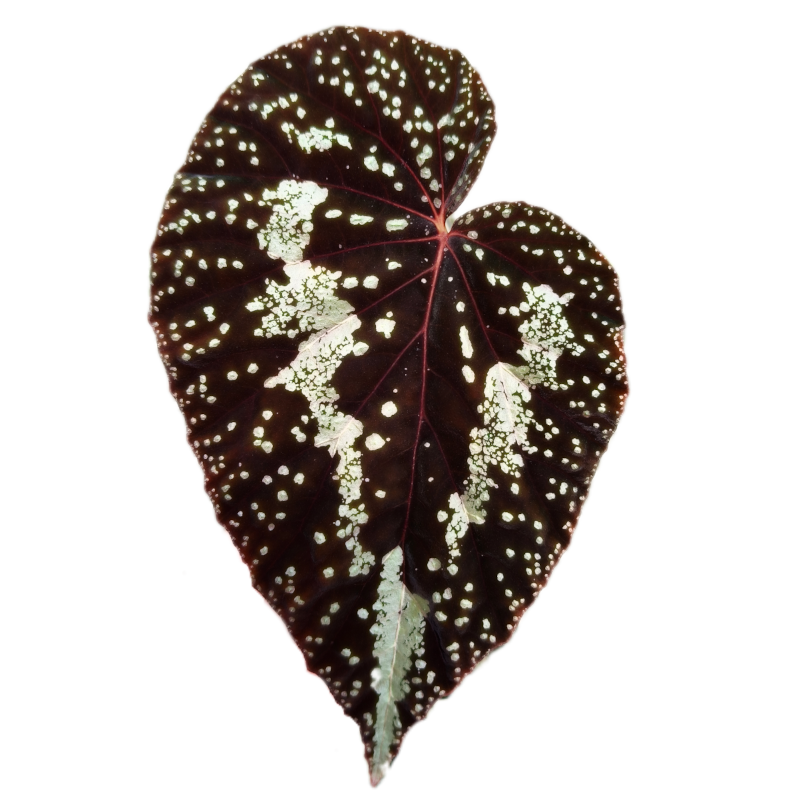

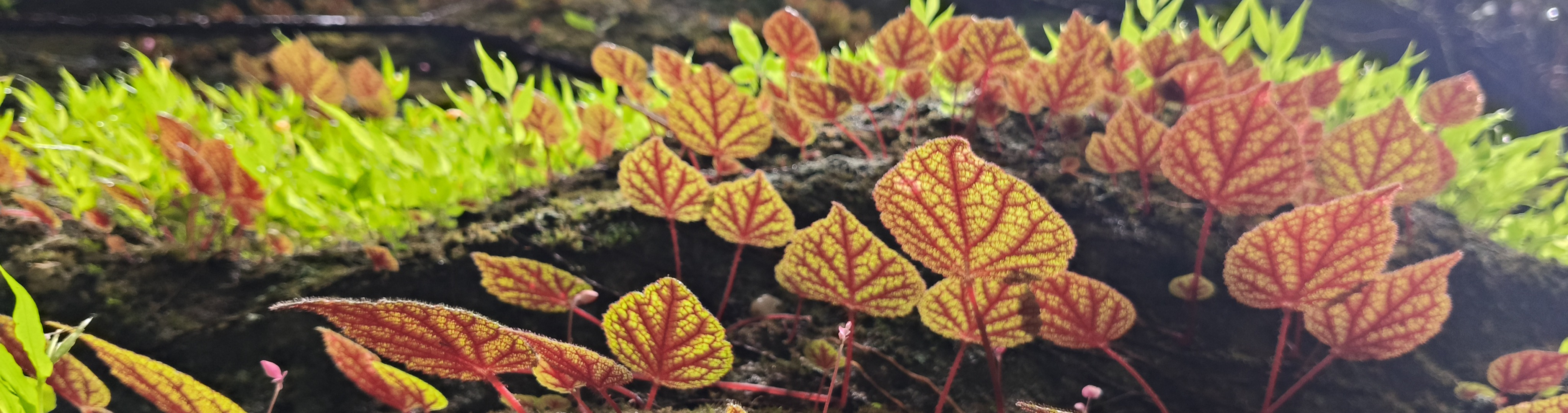
B. isalensis
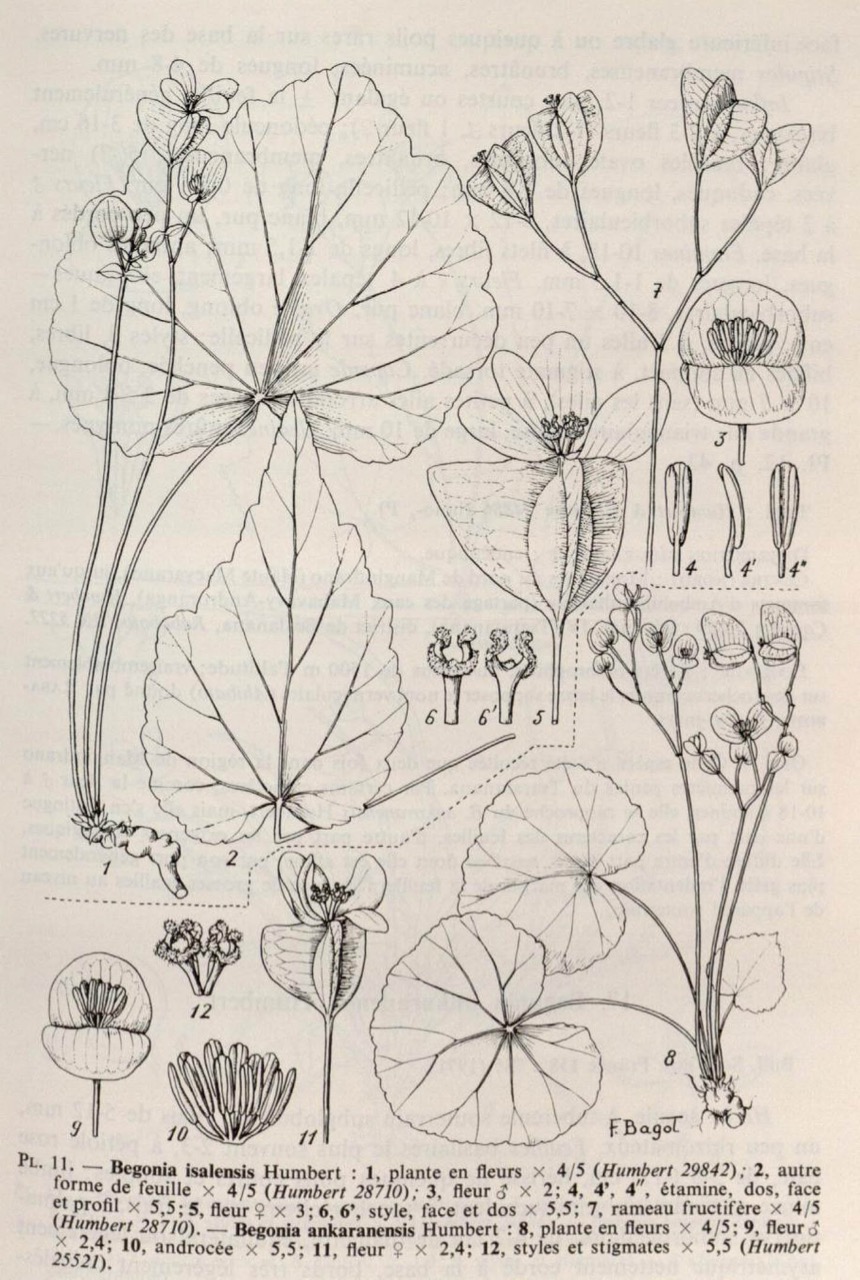
Plant acaule, entirely red (except the upper surface of the leaves) and glabrous; rhizome slightly loosened, sometimes tuberous. Leaves 1 or 2 per foot; petiole very short or 2.5-12 cm long thick; blade 5-7-palmatinerve, suborbicular to ovate, somewhat dissymmetrical, cord at base, almost always terminates in acute apex, 5-10 cm long and broad; crenellated edges, upper face dark green; bi- or trifurque veins finely projecting on both sides. Stipules in lanceolate scales, acumines, 5 mm long. Inflorescence basilaria, most often solitary, in bipolar bisexual cymes, pauciflora; common peduncle naked 6-20 cm long, thick; bracts oblong, acute at the apex 5 mm long. MALE flowers with pedicel 5-10 mm, thick; 2 orbicular tepals (8-9 mm in diameter), elliptical and 14 X 10 mm, pink. Stamens 8-12, free, with 1 mm long thread; antheres 2-2.5 mm long connective rounded at the top. FEMALE flowers with a pedicel of 10 mm accrescent up to 3 cm under the wall fruit; 4 elliptical tepals of 8-10 x 3-6 mm or orbicular. Ovary 8 mm long; styles 3, free bifurcated at the top; twisted stigma at the end. Capsule a little flattened, subtriangular, up to 20 mm long and wide; subtronchial wings at the apex, very attenuated towards the base largely obtuse or subacute, the widest of 6-9 mm, at the end transverse reticulum, the two small, 4-5 mm wide. - PL 11 p. 41. The specimen of the Jussieu herbarium: ex herb. Pepper, Madagascar (P-JU 17292) probably refers to this species.
Pests Diseases
- Classification: Species
- Plant Type: Rhizomatous
- Botanical Section: Quadrilobaria
- Origin: Africa, Madagascar
- Originator: Humbert ex Keraudren-Aymonin & Bosser, Bull. Soc. Bot. France
- Date of Origin: 1973
Begonia Community Hub
Share a Growing Update
Loading community updates...