


B. albococcinea
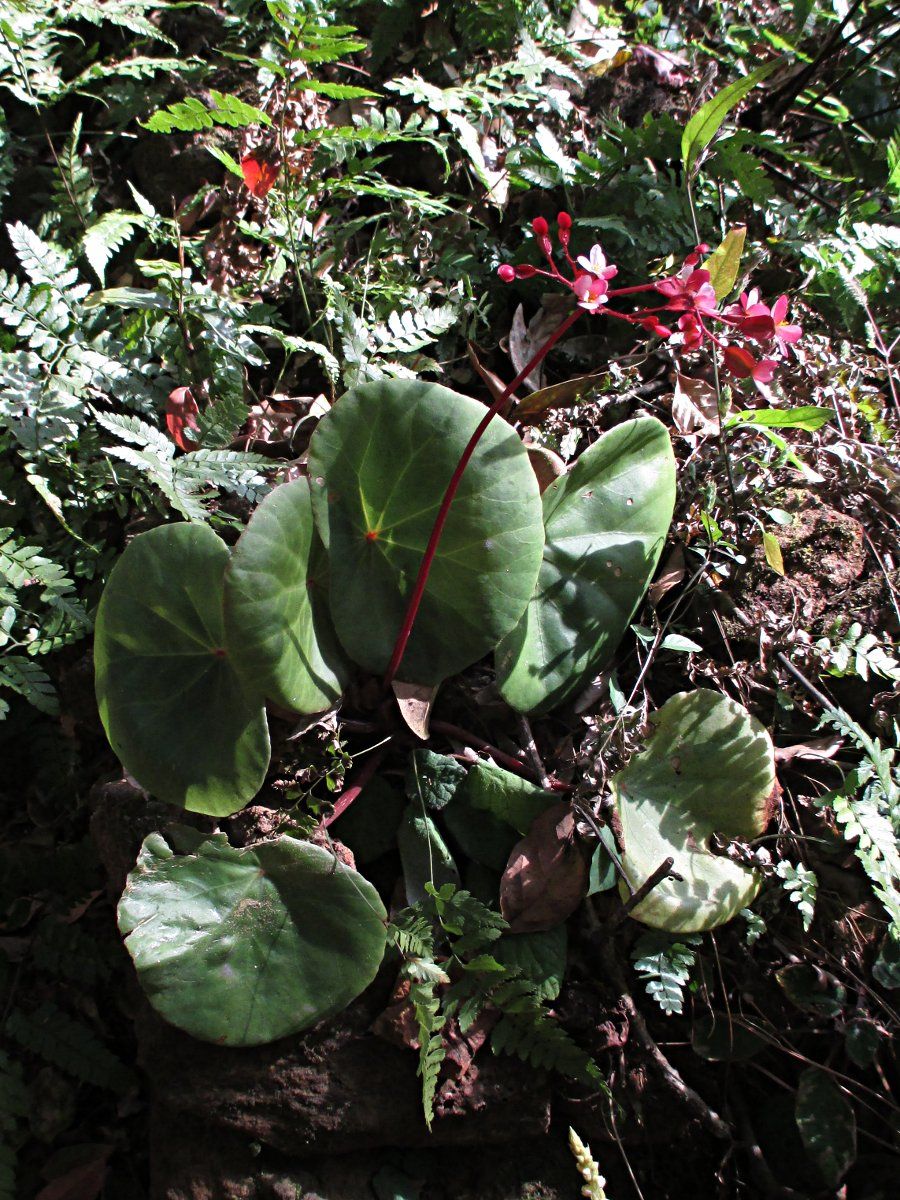
The Floricultural Cabinet and Florist's Magazine. London. Vol. 14: Page 241-4 http://www.biodiversitylibrary.org/item/53965 BEGONIA ALBO COCCINEA (White and Scarlet). - Few tribes of plants possess greater interest than that to, which the ornamental species we now figure belongs. The delicate and pretty colored flowers possessed by most of the kinds, the long time they continue in beauty, and the very graceful manner in which they are produced, are alone considerations of sufficient merit for general appreciation; but besides this, they have a further claim in the remarkable and entertaining diversity which exist in their respective construction, and also that they may be very easily grown and multiplied. The present species is a native of India, and was raised from seed in the Royal Botanic Garden at Kew, where our drawing was prepared in June last. The brilliant contrast of color afforded by the bright scarlet and pure white flowers gives it a very attractive appearance, and it ought to be in the hands of all who admire and are desirous to cultivate this beautiful family. As their proper management is not generally understood, we abridge the following very excellent observations from an article by Mr. James Donald, in the Journal of Horticultural Society, Part II., and hope it may be a means of facilitating their spread; Allgemeine Gartenzeitung. Berlin. v. 13 (1845): Page 247; http://www.biodiversitylibrary.org/item/52464 It is indisputably one of the loveliest plants which cannot be sufficiently appreciated for cold culture, since it is a warmth plant, and blooms in summer months. It is fluffy, with flattened lobed leaves, 5-6 inch long red leaves. The plant grows 1-1.5 feet high, and has reddish, altogether splendid coral red flowers. The fruit is three-lobed, with fairly equal wings. The plant was cultivated in the royal garden at Kew, which was obtained from Strachan, Esq., at Twidenham, Surrey, from India.; Curtis's botanical magazine, v. 71 = ser. 3, v. 1, 1845 B. albococcinea is one of the loveliest of this beautiful Genus, which we cannot too much recommend for cultivation to all admirer of hothouse plants, blooming throughout the spring and summer months; the flowers numerous, white and coral-red. Our plants were raised in the Royal Gardens of Kew, from seeds sent from India by - Strachan, Esq., of Twickenham, Surrey. Description: Stem none; or so short, that the plant may fairly be called stemless. From a short, thick column, spring the tout, red-colored leaf-stalks, two to five or six inches long, terete, with scattered appressed hairs on the surface; their base sheathed with large, lax, membranaceous stipules. Leaves from two to five or six inches in diameter; in general, the length being about equal to that of the petiole, quite glabrous, obliquely ovate, very obtuse, approaching to reniform, the margins slightly reflexed, sinuate, and unequally sub-lobate, peltate, the point of insertion eccentric, and towards the principal sinus. The texture is thick, between fleshy and coriaceous. Scapes a foot to a foot and a half high, twice as long as, or more, than the leaves, terete, red, branched above into a many-flowered, spreading, lax panicle, with small bracts at the setting on of the branches. Male flowers of four sepals; two outer and larger ones, nearly orbicular, red externally, white within: two inner, smaller, obovate white, sometimes tinged with blush. Stamens as in the Genus. Female-flowers with similar sepals to the male, except that the inner ones are sometimes increased to three. Fruit with three, broad, nearly equal angles.
Pests Diseases
- Classification: Species
- Plant Type: Rhizomatous
- Botanical Section: Flocciferae
- Origin: Asia, India
- Originator: Hook.
- Date of Origin: 1845
Begonia Community Hub
Share a Growing Update
Loading community updates...