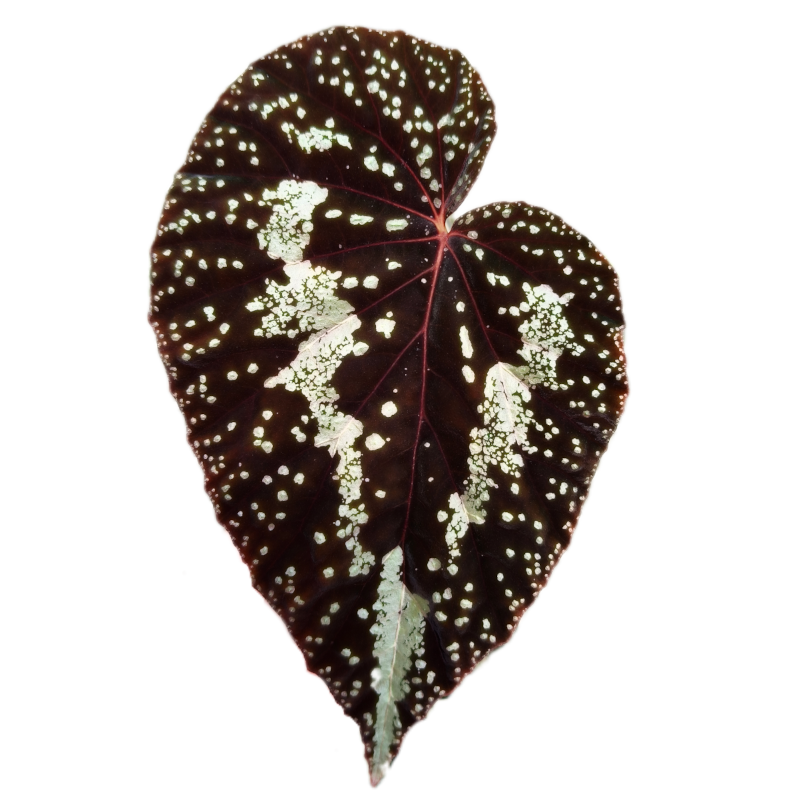


B. 'Mme. Lionnet'
In the 1890’s, four of Lionnet’s cultivars were imported into the US. These were Mme. Lionnet, M. Hardy, President de Boureuille, and Gloire de Jouy. In the US markets, sellers thought the first three were too similar, so they grouped them together and started selling them all under the name Mme. Lionnet.
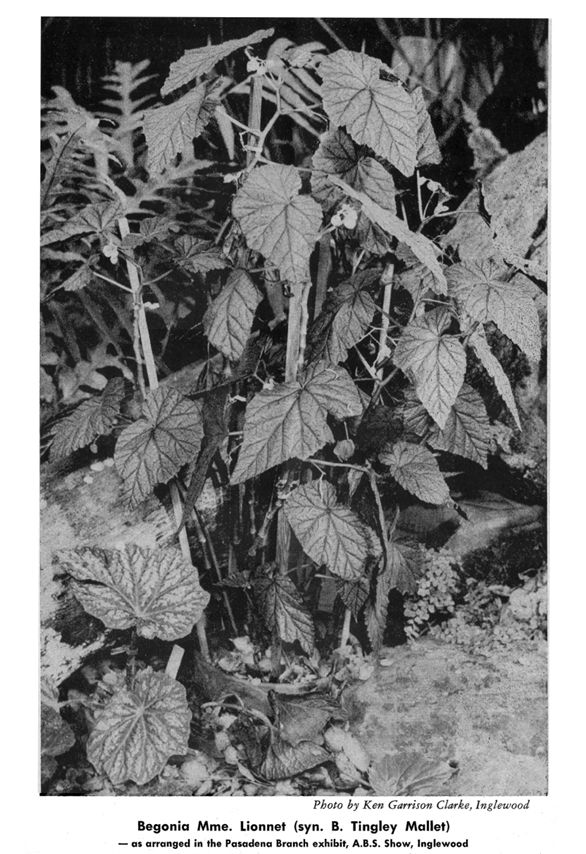
When Tingley Mallet was discovered, it was assumed to be one of these three and given the name Mme. Lionnet. The original Mme. Lionnet may not be synonymous with Tingley Mallet.
Both images are from the US, after the three cultivars were combined and referred to as one. So they are likely the plant we call Tingley Mallet, but it’s unsure which of the original three they are.
In the colorful leaved class of begonias, B. Mme. Lionnet is outstanding. Rumor has it that many years ago this particular begonia was re-discovered in this country in the· gardens of Mrs. Tingley. The discoverer, knowing it belonged to the Mallet group, put the Tingley in front of the name, until such time as the true name should be uncovered. Hence we have been growing this begonia under the synonym for many years and more people are familiar with the synonym than they are with the true name.
According to the records, Mme. Lionnet and Arthur Mallet were of the same cross. B. eldorado x B. incarnata purpurea. B. gloire de jouy, which is associated with this group, had a different parentage.
B. rex hybrid x B. incarnata. B. Margaritacea is the offspring of B. Arthur Mallet x B. coccinea. There is a marked similarity between all these begonias.
Mme. Lionnet is the least difficult to grow and is very popular. While it is usually described as being rather shrubby, growing to a foot and a half tall, the particular plant shown in the picture far outstripped this. It was an exceptionally well-grown specimen. The leaves are medium in size, covered on
the surface with metallic-red small dots, which run together. Each dot on the leaf has a short red hair protruding and in the light this gives the leaves a very red appearance. The veins are depressed and quite dull in color, giving the leaf a nice contrast in shading. The back of the leaf is bright red, with only a few scattered hairs on the veins and there is an uneven collar of hairs around the joining of leaf and stem. The plant is an upright grower with medium green stems, turning woody with age. Inheriting some of the rex characteristics, it is inclined to drop its leaves in winter but it
does not seem to have as long a dormant period as the average rex. While the plant does
seem to do much better during the dormant period by keeping it where it is warm, one of the best plants I have seen was grown outdoors all year round. The nurseryman complained that he had to hide it during the winter because it looked so bare, but the rest of the year it made a nice colorful plant. Incidentally, he didn't know that it was a begonia at all. The plant has large, clear pink flowers and it blooms off and on all year. Only once or twice have I seen the male flowers open and that has been in the middle of winter at that, when no pollen seems to develop. However, the female flowers do open and are a nice contrast to the foliage.
From my own personal experience, I have seen only one cross using this· plant as a parent. I have had reports that the female flowers are infertile but there is always the possibility that there is enough life in one of the flowers to insure a few seeds. It has definite possibilities for hybridizers.
Begonia Mme. Lionnet is colorful of leaf, of medium height, upright. Here then is a good plant for contrast-as it was used by the Pasadena Branch at the 1951 Inglewood A.B.S. Show, nestled in fallen leaves, lichened rock, decaying wood, silvered rex leaves and the greens of ferns. Rich, red contrast to focus the eye. Here, too, is a good plant for massing in formal color schemes, as it was used at the International Show, fronted by borders of lighter leaved semperflorens. And again, as "filler," how useful it is between the lower growing rhizomes and the great cane types, making an admirable "drapery" to conceal the legginess of the big superbas and rubras and lucernas. A plant of many graces.
- Classification: Cultivar
- Plant Type: Cane-like - Mallet
- Origin: Europe, France
- Originator: Lionnet
- Date of Origin: 1895
Begonia Community Hub
Share a Growing Update
Loading community updates...