
B. ‘Orange-Iron’
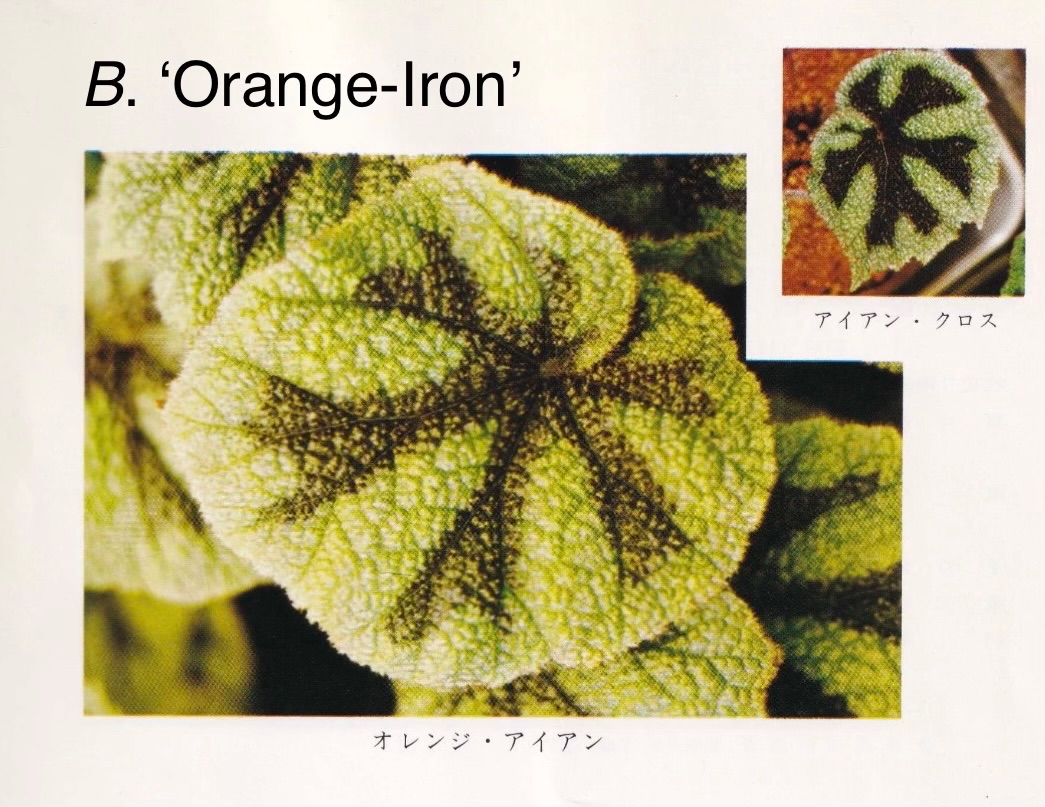
B. ‘Orange-Iron’ was exposed to the lowest
amount of radiation at 0.5 kR Cobalt-60 gamma-
rays. It became a medium-sized plant with a
soft orange-green color. This was one of the two experiments that resulted in a chimeric mutation.
A chimeric mutation means a plant is made up
of two or more different types of cells, the ones
altered by radiation and the ones not altered
by radiation, growing alongside each other.
B. ‘Orange-Iron’ was described as being more
symmetrical and a soft, delicate plant.
Using a 60Co-7 source, adventitious buds of leaf cuttings were irradiated at a dose rate of 500 R/hr, with a total dose of 0.5 kR (1971). The branch mutation was confirmed by pruning, separation by division, and stabilization in 1972.
The leaves are orange-green in color, with a pattern resembling an iron cross in brownish-purple along the veins, similar to that of the parent variety.
The leaves are medium-sized, 15-20 cm long and 13-18 cm wide, nearly circular in shape, almost bilaterally symmetrical, and have fine red to pink hairs along the margins. A compact plant, 30–35 cm tall, that is robust and easy to grow. Propagation method: division (stable chimeric plants). It is used as an indoor potted plant.
- Classification: Cultivar
- Plant Type: Rhizomatous
- Origin: Asia, Japan
- Originator: Naoki Matsubara & Hirokatsu Suda
- Date of Origin: 1972
Begonia Community Hub
Share a Growing Update
Loading community updates...