


B. gracilis var. gracilis
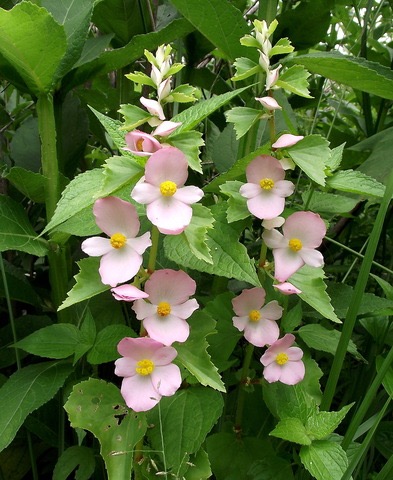
Curtis’s Botanical Magazine, v. 57 = ser. 2, v. 4, 1830 B. gracilis as SYN. B. diversifolia Description: Whole plant smooth and shining. Stem herbaceous, twining, branched, smooth, very obscurely angled, trans parent. Stem-leaves alternate, petiolated, half-cordate, acuminate, somewhat lobed toward the base, acutely and unequally serrated, smooth, bright-green above, paler and somewhat glaucous beneath. Nerves branched, and prominent behind. Petiole shorter than the leaves, spreading, flattened on the upper side. Root-leaves kidney shaped, nearly equal at the base, broadly crenate, on petioles, many times longer than themselves, and which are lightly compressed at the sides and channeled above; a few leaves at the bottom of the stem, resemble these, but are on shorter petioles, and have their edges pretty equally lobed, the lobes being unequally and sharply serrated. Stipules ovate, oblique, green, ciliated. Peduncles axillary, about as long as the petioles on the lower part of the stem, longer above, slightly compressed, bracteated, pedicels rising from the axil of the bracts, solitary, or two together, a male and female. Occasionally the peduncle is twice divided, with a pair of opposite bracts at each division; and it is extremely probable, that at another season of the year, the inflorescence would look very differently, and the plant assume a much handsomer appearance, from perfecting many more flowers; for in the axil of each leaf, from whence the peduncle springs, and in the bosom of each bract, there is a cluster of flower buds. Bracts cordato-ovate, concave, blunt, entire, shorter than the pedicels. Corolla rose-colored; outer petals cordato-ovate, pointed, sharply serrated; inner petals obovato-elliptical, entire, subacute. Stamens yellow, monadelphous; union of the filaments extending high. Anthers (as is common in the whole of this genus) obovate, truncated, compressed, the pollen cases being distant, lateral, and connate. Germen with three unequal sides, unequally winged, of three somewhat unequal loculaments, each containing a large, green, bipartite, waved, seminal receptacle., covered with minute ovules; the largest wing acute, the second subacute, and the third very small and rounded. As far as I can judge by the imperfect characters which have been published of this beautiful and extensive genus, the present species is undescribed. It was raised from seed, sent from Rigla in Mexico, by Captain Veitch, to P. Neill, Esquire, in whose stove at Cannonmills, near Edinburgh, it flowered in October, 1829. GRAHAM. We are indebted to the pencil of Dr. Greville for the drawing from which our engraving was taken.; Curtis's botanical magazine, v. 136 = ser. 4, v. 6, 1910 B. gracilis var. gracilis as SYN. B. martiana var. gracilis: The handsome Begonia which forms the subject of our plate is perhaps best considered a garden race of B. martiana, Link and Otto, a native of Mexico, which the late Dr. A. de Candolle considered to be itself no more than a variety of B. gracilis, Kunth. The examination of a large series specimens however, has lead Dr. Rolfe to take the view that the two are, overall, better treated as distinct species; B. gracilis is always a smaller plant than normal B. martiana, with slender and never strictly erect stems, while it has much more divided leaves and · a different inflorescence. As thus separated B. martiana is represented in gardens by three more or less readily distinguishable forms, known respectively as var. grandiflora, var. pulcherrima, and var. racemiflora. They differ but slightly from each other and have all been familiar plants in Begonia collections during the past twenty years. All three are good garden plants, with stems sometimes reaching 2 ft. in height when well grown, though when are mall in size and weak in growth owing to having received unsuitable treatment, they are alike in bearing a close resemblance to B. gracilis, with which, as already remarked, their identity has been suggested. Of the three forms, that now figured from a plant which flowered in the Kew collection in July 1909, is certainly the finest, and the extent to which selection has led, in this case, to the evolution of an improved garden race may perhaps be best estimated by a comparison of our illustration with that given, at plate 2960 of this work, of B. diversifolia, Graham, which is now recognized as being only a state of B. Martiana. Our plant grows well when kept in a frame or greenhouse and shaded from bright sunshine. The whitish, irregularly shaped tubers lie dormant from about October until the following April, when they develop several stems which grow rapidly and flower freely in July. The plants ripen seeds and produce clusters of small bulbil-like buds which may be used for propagation in place of seeds, in the axil of the leaves. Description: Herb; terrestrial; tuber ellipsoid-oblong, fleshy, about 2 in. long; stem 1-1½ ft. high; branches erect, fleshy, glabrous, leafy. Leaves petioled, obliquely cordate, somewhat acute, twice crenate, glabrous or sparingly hairy, 3-6 in. long, 2-3 in. wide; petioles 1/3-1 ¼ in. long; stipules wide ovate, almost entire. Flowers bracteate and bracteolate, axillary solitary or clustered, large, rode-pink, the males 4-merous, the females usually 5-merous; bracts leafy, gradually diminishing upwards and subconcave; bracteoles wide ovate, obtuse, almost membranous. Sepals suborbicular, 1- 1¼ in. wide, subconcave. Petals suborbicular, 5-8 lin. wide. Stamens many, their filament connate below in a short column. Style 3, connate below, 2-armed above. Capsules 3-winged, the wings unequal, crenulate; the apex tipped by the persistent styles.
- Classification: Species
- Plant Type: Tuberous
- Botanical Section: Quadriperigonia
- Origin: America, Mexico
- Originator: Kunth in Humboldt, Bonpland & Kunth, Nov. Gen. Sp.
- Date of Origin: 1825
Begonia Community Hub
Share a Growing Update
Loading community updates...