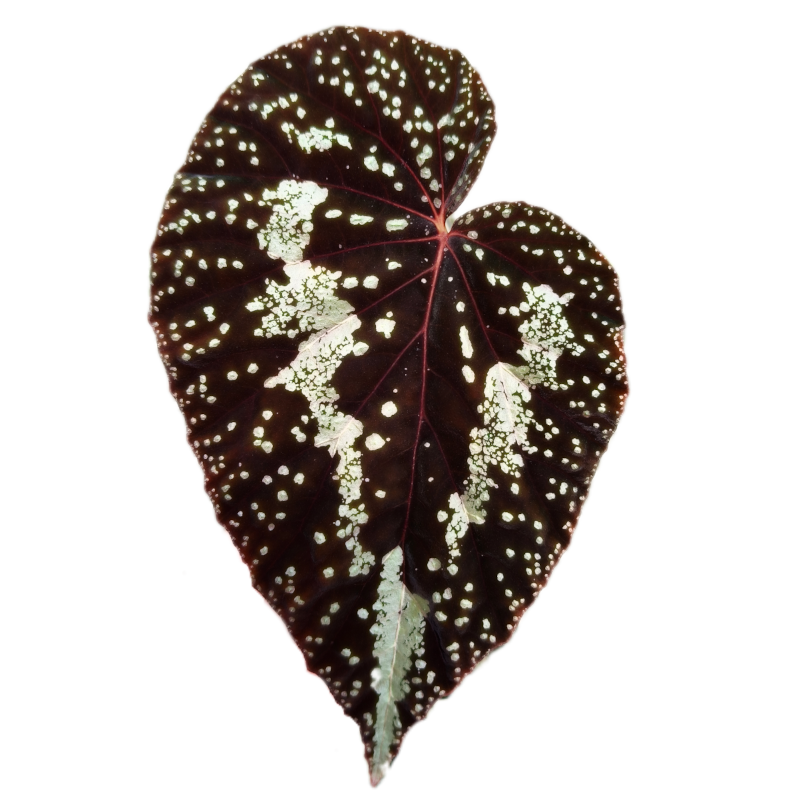

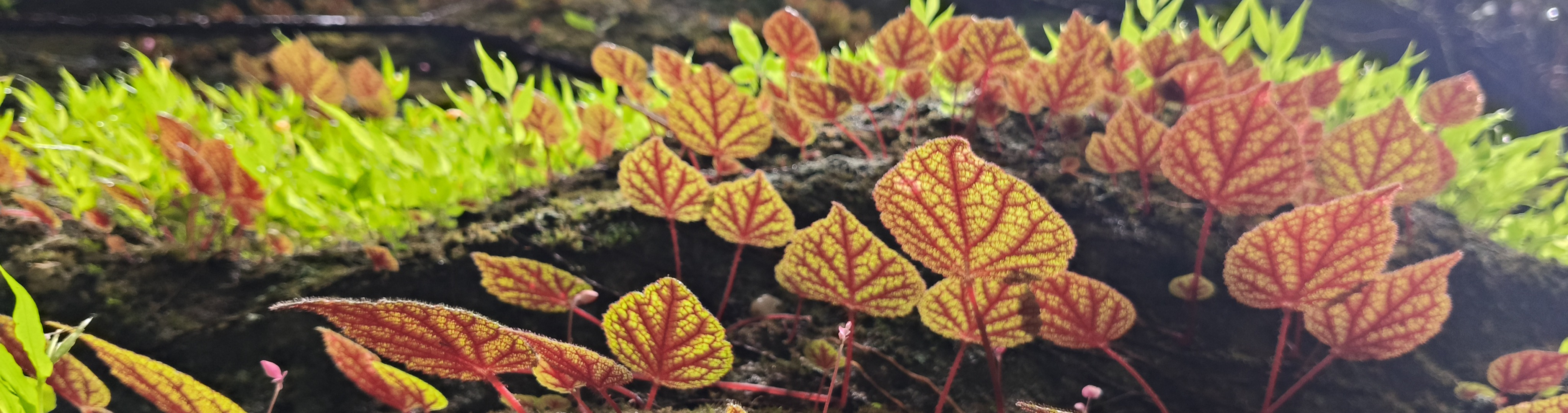
B. hughesii
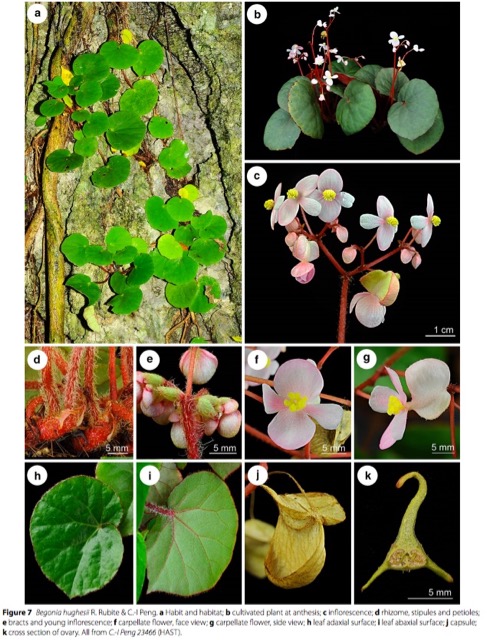
Lithophyte; Three new species of Begonia endemic to the Puerto Princesa Subterranean River National Park, Palawan; Rubite, et al https://www.ncbi.nlm.nih.gov/pmc/articles/PMC5432911/ Begonia hughesii R. Rubite & C.-I Peng, sp. nov. § Baryandra (Figures 6, ,77) TYPE: PHILIPPINES. Palawan Island, Palawan Province, Puerto Princesa City, Puerto Princesa Subterranean River National Park, elev. ca. 5 m, 10°12′1″N, 118°55′32″E, 2 Nov. 2011, Ching-I Peng 23466, with Kuo-Fang Chung, Chien-I Huang, Rosario Rubite (holotype PNH, isotype HAST). Begonia hughesii is most similar to B. acclivis, but differs in having leaves which are glabrous above (not with scattered 2 mm long hairs) and uniform bright green (not markedly variegated), and dimorphic stipules which are either hairy on the keel only or hairy all over the abaxial surface. Lithophytic rhizomatous herb ca. 20 cm tall. Stem 5–10 mm thick, tomentose (2–3 mm brown hairs) becoming glabrous in parts with age, internodes 3–8 mm long. Stipules triangular, asymmetric, 10–12 × 9–11 mm, heteromorphic, alternately either with brown hairs on the keel only, or tomentose all over abaxially, hairs brown, 2–3 mm long, keeled, keel extending at the tip for ca. 2 mm, ring of hairs at base of petiole absent. Leaves on erect petioles; petioles 6–15 cm long, 4–6 mm in diameter, terete, red, tomentose even when mature and with 2 hair types, one linear, the other thicker towards the base; lamina basifixed, thick and fleshy in life, drying opaque and stiff, ovate, 7–10 × 5–7.5 cm, apple-green above, pale green below, glabrous above except for minute pubescence near the petiole attachment, below hairy on the veins only with ca. 2 mm long hairs, venation palmate, main veins 7; margin maroon, broadly and shallowly undulate, dentate-sinuate, ciliate with pink hairs (1–1.5 mm); tip shortly acuminate; stomata in clusters of 2–5. Inflorescence erect, ca. 20 cm long, bisexual, male and female flowers open at the same time as the inflorescence matures, cymose, branching 4 times; primary peduncle ca. 15 cm long, with scattered hairs (much less dense than on the petioles), bracts small, ovate, 1.5–2 × 1.5–2 mm, with minute scattered glandular hairs. Male flowers: pedicel 7–10 mm long, with sparse minute glandular hairs; tepals 4, uniformly very pale pink or white, entire, with a few minute glandular hairs adaxially; outer 2 sub-orbicular 8–9 × 6–7 mm; inner 2 obovate, slightly retuse, 6 × 3 mm; androecium with ca. 40 stamens, sessile; filaments free, unequal, 1–1.75 mm long, longer filaments found in the center of the androecium; anthers yellow, 1.25 mm long, oblong-oblanceolate, slits lateral becoming unifacial at the apex; connective extended. Female flowers: pedicel 7–10 mm long, with sparse glandular hairs; ovary 10 × 14 mm including wings, pink; capsule 9 × 5 mm, two-locular, placentae bifid; wings 3, unequal, larger wing cucullate, smaller wings rounded; tepals the same as in the male flowers; styles 3, stigmatic surface spirally twisted. Fruit pedicel 7–12 mm, drying pale brown, 9–14 × 14–18 mm, recurved with the 2 lateral wings (9–14 × 3–4 mm, round) forming a splash cup, the larger wing markedly cucullate, 9–14 × 7–9 mm, apex truncate. Somatic chromosome number, 2n = 30. Distribution, habitat and ecology Begonia hughesii herbarium material has been collected from the type locality near the entrance to the Underground River and on Ugong Rock near Sabang and on limestone outcrops at the base of Mt. St. Paul. Further photographic evidence reveal records from the other side of the Babuyan River at PPURNP and within the forest on Cleopatra’s Needle (Jonah Van Beijnen, pers. comm.). The species grows on eroded limestone in semi-shade under broadleaf forest, and was flowering and fruiting when collected in early November. In cultivation in the greenhouse of Academia Sinica in Taipei, Taiwan, it flowered and fruited from July to December. Etymology The species epithet is named after Dr Mark Hughes of the Royal Botanical Garden Edinburgh, who studies extensively Southeast Asian begonias including Philippine Begonia. Additional specimens examined (paratypes) PHILIPPINES. Palawan, Sabang, Ugong Rock, 10°5′13″N, 118°51′16″E, elev. ca. 60 m, in limestone outcrops, semi shaded, locally abundant, 2 Nov. 2011, Ching-I Peng 23475, with Kuo-Fang Chung, Chien-I Huang, Rosario Rubite (HAST); Palawan, Mt. St. Paul, elev. 300–600 m, slope forest on karst limestone, 03-05 May 2012, Hughes & Tandang MH1726 (HAST); Palawan, Puerto Princesa Subterranean National Park, Sabang, jungle trail between CPS and underground river, elev. 50 m, 29 May 2012, M. Hughes, C. Puglisi, D. Tandang & Julius CP305 (E, PNH). Proposed IUCN Red list category LC. The species has a fairly wide distribution within the PPURNP and surrounding forests on Mt St Paul and Cleopatra’s Needle, and providing these areas remain well managed B. hughesii can be considered as Least Concern.
- Classification: Species
- Plant Type: Rhizomatous
- Botanical Section: Baryandra
- Origin: Asia, The Philippines
- Originator: Rosario Rivera Rubite 1, Mark Hughes 2, Patrick Blanc 3, Kuo-Fang Chung 4, Hsun-An Yang 5, Yoshiko Kono 5, Grecebio J D Alejandro 6, Llogene B De Layola 1, Arthur Gregory N Virata 1, Ching-I Peng
- Date of Origin: 2015
Begonia Community Hub
Share a Growing Update
Loading community updates...