


B. glandulosa
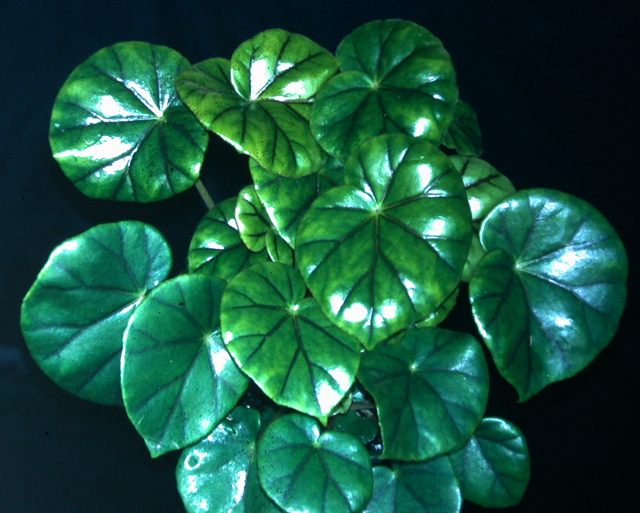
Curtis's botanical magazine, v. 87 = ser. 3, v. 17, 1861 B. glandulosa: This plant was received from Mr. Linden seven years ago, under the name of B. nigro-venia. It is certainly identical with a plant called in our herbarium B. glandulosa, A. DC., by De Candolle himself, when preparing the Begonias for publication in the forthcoming volume of the 'Prodromus,' and which was gathered by Seemann at Veraguas. (See Ann. Sc. Nat. ser. iv. vol. ii. p. 14.) This plant, however, agrees with Liebmann's description of B. multinervia, from Costa Rica, so closely that it is not improbable that they may be the same. Description: Rhizome stout, prostrate, ascending, covered with stipular scales. Petioles a span long and upwards, terete, bright-red, rather hairy. Leaf four to six inches broad, of a fleshy texture, obliquely broadly ovate or cordate, or almost rotundate, with an open or closed deep sinus, and obscurely sinuate- toothed margin , glabrous, or very light]y hairy, shining on both sides but most so below, deep-green above, the veins painted with broad black or ferruginous band , paler beneath, painted red, and cuticle covered with minute pustule .Scape slender, terete, very tall, bearing a profusely-branched Cyme, with deep-red branches and pedicels. Flowers very numerous and rather small, pale-green or whitish: males smaller, with two, broadly ovate, blunt sepals, and six to eight stamens; females with four, oblong sepals, and capitate stigmas. Large wing of fruit triangular, blunt. Begonia glandulosa A. DC. Flora of Costa Rica. Begoniaceae. by Paul C. Standley. Chicago 1937. v. 18: pt. 2 (1937): Page 737-48 http://www.biodiversitylibrary.org/item/19747 Reported as collected in Costa Rica by Hoffmann. Also in Panama. Plants erect, simple or branched, the branches and petioles fuscous-pilose; leaves on rather long petioles, the blades transversely and broadly oblique-ovate, 10- 15 cm. long, palmately 9-nerved, very shortly caudate-acuminate, shallowly cordate at the base, undulate-crenulate, glabrous above, puberulent beneath at the base of the nerves; peduncles as long as the leaves, glabrate, the cymes broad, several times dichotomous; pistillate flowers 4-lobate; capsules 4 mm. long or larger, the larger wing much elongate, obtuse or acutish, directed upward, dotted with pellucid glands.- Curtis’ Illustrated, Bot. Mag. pl. 5256 .
Pests Diseases
- Classification: Species
- Plant Type: Rhizomatous
- Botanical Section: Gireoudia
- Origin: America, Mexico
- Originator: A.DC. ex Hook.
- Date of Origin: 1861
Begonia Community Hub
Share a Growing Update
Loading community updates...