
B. paganuccii
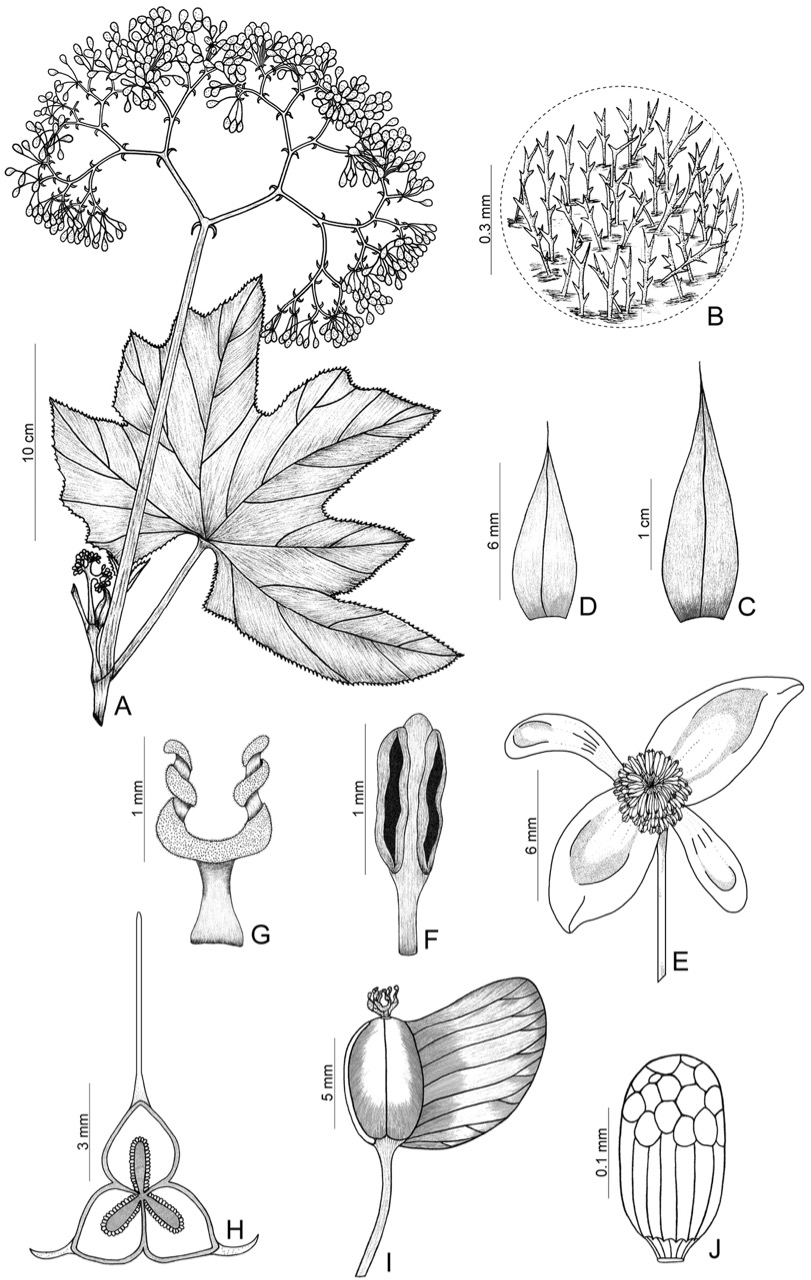
Subshrub, ca. 3 m high, monoecious, pubescent, with both dendritic greyish trichomes, 0.1–0.4 mm long, and microscopic glandular trichomes. Stem erect, fleshy, pubescent; internodes 1–3.5 cm long. Stipules 2.5–3 × 0.7–1.5 cm, lanceolate, apex apiculate, margin entire, pubescent, carinate, appressed, caducous. Leaves: petiole 6.3–11.6 cm long, cylindrical, pubescent; blade 13–18 × 19–28 cm, transversally elliptic, deeply lobed (lobes approximately half the length of their main vein), 6 or 7 lobes, asymmetric, basifixed; base cordate; lobes with acute apex; margin serrulate; pubescent on both surfaces, more densely so on abaxial surface, discolorous, adaxial surface green, abaxial surface green-cinereous; venation actinodromous, 6 or 7 veins at base, slightly thickened. Inflorescence: dichasial cyme 32–39 cm long, ca. 180 flowers; peduncle 23.5–27 cm long, cinereous; first order bracts 4–6 × 1.5–2.5 mm, lanceolate, apex acuminate, margin entire, caducous. Staminate flowers: pedicel 1–1.4 cm long, pilose; tepals 4, white, the outer pair larger 6–7.2 × 3–4 mm, ovate to elliptic, apex acute to obtuse, margin entire, concave, glabrescent on abaxial surface, the inner pair 5–6.2 × 1.8–2.3 mm, oblong to oblanceolate, apex obtuse to rounded, margin entire, concave, glabrous; androecium actinomorphic, stamens 32–48, filaments 0.2–0.9 mm long, free, anthers 1–1.3 mm long, rimose, connective prolonged. Pistillate flowers [not seen]: bracteoles 2, opposite, borne on pedicel, just below ovary, caducous [scars seen on the pedicel from capsules]; styles 3, 1.6–2 mm long, bifid, branches spirally-arranged, stigmatic papillae covering branches, stigmatic surface papillose, yellow [obtained from capsules]; ovary 5–6.7 mm long, trilocular, placentation axile, placenta entire [observed from capsules]. Capsules 6–7.5 × 11–14.6 mm [including wings], three-winged, glabrescent, brown when mature, dehiscing at the basal portion; wings unequal, larger one 5–7 × 6–7 mm, apex obtuse to rounded, smaller ones 5.8–7 × 0.6–1.6 mm. Seeds ca. 0.3 mm long, oblong. Begonia paganuccii is similar to B. gardneri A. DC. However, it can be easily distinguished by the indumentum of dendritic trichomes (vs. simple trichomes); stipules lanceolate and pubescent (vs. ovate and glabrous); staminate flowers with the outer pair ovate to elliptic and the inner pair oblong to oblanceolate (vs. both pairs obovate); endemic to the State of Bahia (vs. endemic to the State of Minas Gerais State). Begonia paganuccii is characterised by a dendritic indumentum, stipules lanceolate, and transversally elliptic leaf-blades, 6- or 7-lobed. Trichomes are quite important in the taxonomy of Begoniaceae when combined with other morphological information (Jacques 2002). Some species in Brazil have dendritic trichomes, such as Begonia egregia N.E. Br and B. lindmanii Brade. Begonia paganuccii differs from B. egregia by the basifixed, lobed and transversally elliptic (vs. peltate, entire and ovate to elliptic) leaf-blade, staminate flowers with 4 tepals (vs. 2) and pistillate flowers with trilocular ovary and 3 styles (vs. ovary tetralocular and with 4 styles). It also differs from B. lindmanii by the lobed (vs. entire) leaf-blade, as well as by the many-flowered dichasial cyme (ca. 180 flowers vs. 10–15 flowers) and pistillate flowers with 2 bracteoles (vs. 3 bracteoles). This species can be distinguished from the remaining species of Begonia from the region where it occurs using the key below. Due to the leaves with cystoliths and the entire placenta, it most likely belongs to the sect. Pritzelia (Klotzsch) A. DC.
Pests Diseases
- Classification: Species
- Plant Type: Unknown
- Botanical Section: Pritzelia
- Origin: America, Brazil
- Originator: Gregório & J.A.S.Costa, PhytoKeys
- Date of Origin: 2015
Begonia Community Hub
Share a Growing Update
Loading community updates...