


B. françoisii var. françoisii
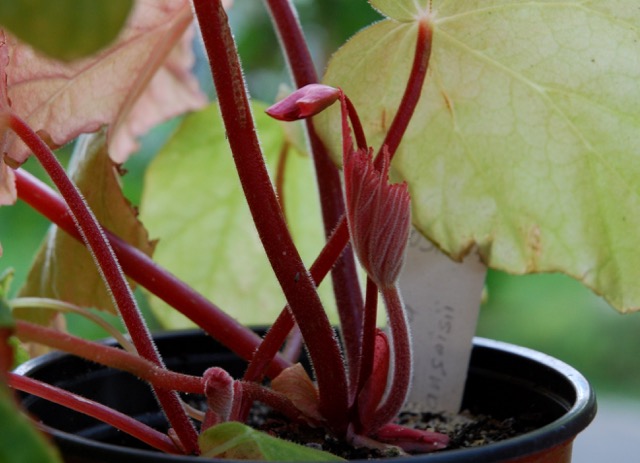
Very short, thick-stemmed plant: large underground tuber that can grow to the size of a fist or extend between the rocks. Leaves 2 to 4 to 10-20 (-30) cm petiole long red hairs, dense in the young state; Fragile membranous limb, easily tearing, orbicular to subreniform, 10-40 (-80) x 15-40 (-60) cm, easily changed from green to red depending on the density of the hair (very dense hairs). young state, notes of the harvesters) in tip long at the top, deep rope at the base, the two lobes being able to be covered, upper face of the limb punctuated with reddish hairs, spicules, inferior face only pubescent on the veins; undulating-dentee edges; teeth terminated by a thin peak; 7 basal basal nerves finely prominent and pubescent on the inferior face; hair denser and longer towards the petiole; 2-3 pairs of very ascending secondary nerves, only visible below. Triangular Stipules 8-10 X 5-7 mm. Inflorescences 1-2, in bipar cymes; white flowers, ross or pale pink, glabrous, rather loose; axis up to 20-100 cm, quite robust, glabrous, first branches 5-8 cm long, the second 3-4 cm; deciduous bracts; pedicel glabrous, 10-15 mm long, thin. MALE flowers have 2 oval, or obovate tepals and attenuate towards the base, 12-15 x 15-17 mm. Stamens 30 to 40, fascicles; long antheres, 5 mm long; free nets, 1-2 mm long. FEMALE flowers has 4 oval tepals, the external ones of 12-15 x 10 mm, the internal ones a little more narrow. Ovary oblong, 9-10 mm long, has 3 wings; 3 bipartite placentas; widest wing 10 mm wide; styles 3, bifid on their half; stigma papillose, strongly spiral blade. Ovate capsule, 10-12 mm long, has 3 wings, the two small 3 mm wide, the largest of 12 mm; reticulum well mark, transversal. Obovate seeds, 0.4 mm long; tegument reticules. - Pl. 15, p. 51. According to the notes of Perrier de la Bathie, the samples collected by him in the Manongarivo massif (6670, 6671, 6681, 6684) belong to very similar species, with a similar habit, differing from each other only by vestiture of the limb and petioles. And he concluded: but these are extremely variable species! Specimens 6670 and 6671 belong to the variety B. francoisii, specimens 6681 and 6684 are to be related to the variety B. glabra. The quotation (Neth., J. Agr.Sci., 21, 1973) of an indeterminate Malagasy Begonia, chromosome number 2n = 38, counts from a specimen grown in Munich, from Bekolosa (= Bekolosy, Massif du Manongarivo) could relate to this species. Harvest of J. Bogner.
Pests Diseases
- Classification: Species
- Plant Type: Rhizomatous
- Botanical Section: Quadrilobaria
- Origin: Africa, Madagascar
- Originator: Guillaumin, Bull. Mus. Hist. Nat. (Paris)
- Date of Origin: 1925
Begonia Community Hub
Share a Growing Update
Loading community updates...