
B. elianeae
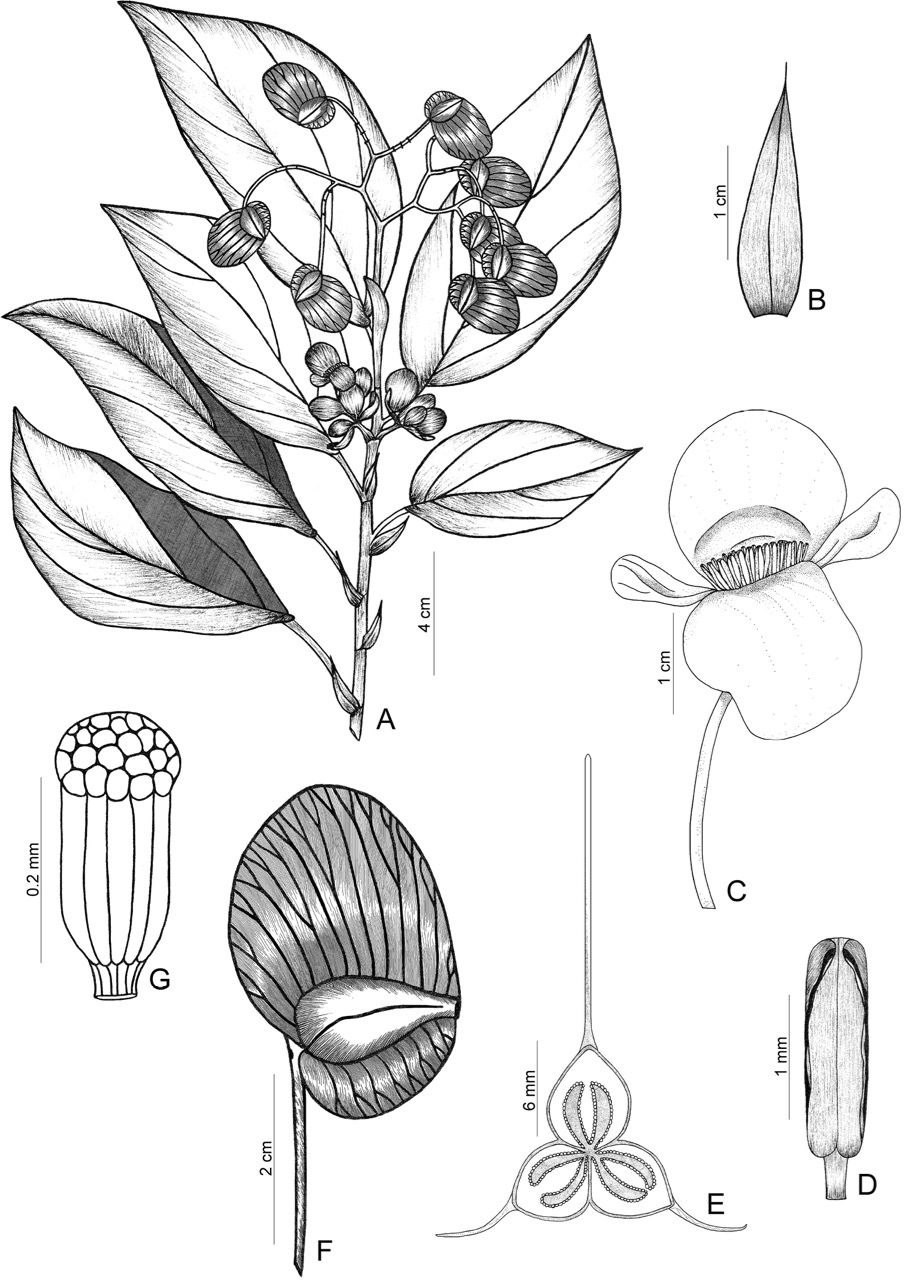
Shrub, 1–2.5 m high, monoecious, with sparse minute, simple hairs and microscopic glandular hairs to essentially glabrous. Stem erect to scandent, fleshy, sparsely pilose, longitudinally striate in herbarium specimens; internodes 1.7–5 cm long. Stipules 1.7–3.5 × 0.6–0.8 cm, lanceolate, apex apiculate, margin entire, with minute hairs to essentially glabrous, appressed, persistent. Leaves: petiole 1.3–3.3 cm long, cylindrical, with minute hairs to essentially glabrous; blade 13–18.2 × 6.2–8 cm, oblong to obovate, entire, asymmetrical, basifixed; base oblique; apex acuminate; margin entire to slightly undulate, glabrescent to glabrous on both surfaces, discolorous, adaxial surface green, abaxial surface light green to vinaceous; venation craspedodromous, thickened. Inflorescence: dichasial cyme 9–15 cm long, 4–8-flowered; peduncle 4,5–6 cm long, with minute hairs to essentially glabrous, vinaceous; first order bracts ca. 15 × 6 mm, obovate, apex rounded, margin entire, caducous. Staminate flowers: pedicel 10–14 mm long, glandular; tepals 4, white, the outer pair larger, 15–17 × 15–17 mm, orbicular to ovate, apex rounded, margin entire, concave, glabrescent on abaxial surface, the inner pair 12–14 × 3–4 mm, elliptic to oblanceolate, apex acute to obtuse, margin entire, concave, glabrous; androecium actinomorphic, stamens 26–34, filaments 0.1–1.2 mm long, free, anthers 2–3 mm long, rimose, connective not prolonged. Pistillate flowers [only seen in bud]: bracteoles 2, opposite, borne on pedicel, just below the ovary, caducous [not seen; inferred by pedicel scars on flower bud]; pedicel of floral bud ca. 1 cm long; tepals of floral bud 5, 9.2–10 × 5–7 mm, three slightly larger ones, elliptic, apex acute to obtuse, margin entire, glabrescent on the abaxial surface, white [styles damaged]; ovary ca. 7.5 mm long, trilocular, placentation axile, placenta bifid [obtained from capsules]. Capsules 1.8–2 × 2.7–3.7 cm [including wings], three-winged, glabrescent, light green, young wings vinaceous, becoming brown at maturity, dehiscing at the basal portion; wings unequal, larger ones 2–2.3 × 1.7–2.1 cm, apex obtuse to rounded, smaller ones 1.5–1.8 × 0.6–0.8 cm, rounded. Seeds ca. 0.3 mm long, oblong. Begonia elianeae is similar to B. besleriifolia Schott, but is easily distinguished from that species by leaf-blades glabrescent to glabrous on the abaxial surface (vs. sericeous); dichasial cyme with 4 to 8 flowers (vs. 40 to 60); tepals of staminate flowers larger (outer ones: ≥ 15 × 15 mm vs. ≤ 7.5 × 5.3 mm long; inner ones: ≥ 12 × 3 mm vs. ≤ 6 × 3 mm long); filaments shorter (≤ 1.2 mm vs. ≥ 1.5 mm long) and anthers larger (≥ 2 mm vs. ≤ 1.5 mm long); capsules larger (≥ 1.8 cm vs. ≤ 1.5 cm long), with larger wing (≥ 2 cm vs. ≤ 1.2 cm long). Begonia elianeae is a shrub characterised by the large oblong to obovate leaf-blades, and by the large, yet few-flowered inflorescences and few-fruited infructescences. In Begonia, shrubby species are not so common and only two species with this habit occur in the state of Bahia: B. elianeae and B. besleriifolia. Both have craspedodromous leaves and can be distinguished from all other species from southern Bahia with this type of venation using the key below. The most likely section of B. elianeae is the sect. Ruizopavonia A. DC., which consists of suffrutescent plants, with woody stem, straight, craspedodromous leaves, and bracts and styles caducous in fruit.
Pests Diseases
- Classification: Species
- Plant Type: Unknown
- Botanical Section: Pritzelia
- Origin: America, Brazil
- Originator: Gregório & J.A.S.Costa, PhytoKeys
- Date of Origin: 1995
Begonia Community Hub
Share a Growing Update
Loading community updates...