


B. langsonensis
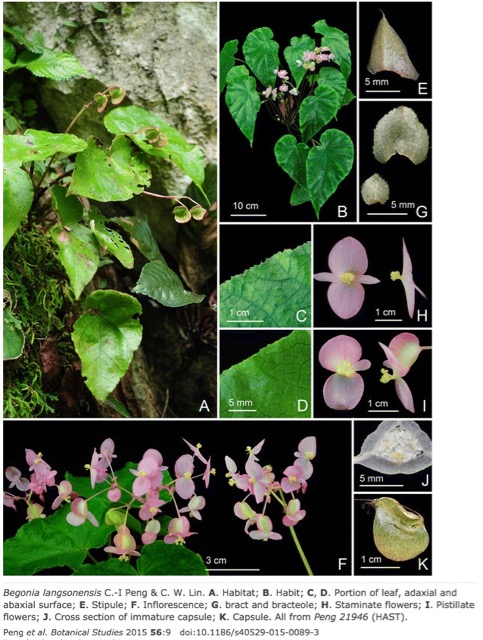
Resembles B. ornithophylla; TYPE: VIETNAM. Lang Son Province, Huu Lung District, Huu Lien Commune, Tam Lai Village. N 21°39’60”, E 106°22’53”, elev. ca. 140 m. Living collection made on 20 November 2008; type specimens pressed from plants cultivated in the experimental greenhouse in Academia Sinica, Taiwan, 15 November 2012, Peng 21946-A (holotype: HAST; isotypes: A, E, HN, MO) (Figures 8 and and99). Herb, monoecious, rhizomatous. Rhizome creeping, to 10 cm or longer, 0.6–1.7 cm thick, internodes congested, glabrous. Stipules deciduous, reddish pale green, widely ovate-triangular, 0.7–1 cm long, 0.7–1.1 cm wide, herbaceous, strongly keeled, glabrous, apex aristate, arista ca. 0.3 cm long. Petioles brownish green, terete, 13–25 cm long, 0.3–0.7 cm thick, glabrous. Leaves alternate, blade asymmetric, obliquely ovate, 11–22.5 cm long, 6–13.5 cm wide, broad side 3.3–6.8 cm wide, basal lobes cordate, 2.7–5.5 cm long, apex attenuate, caudate, base strongly oblique-cordate, margin serrulate and puberulous, thickly chartaceous, adaxially uniformly emerald green, very sparsely minutely scabrescent, abaxially pale green, sparingly puberulous or subglabrous; venation palmate with 6–8 primary veins, midrib distinct, secondary veins 2–4 on each side, minor veins reticulate, all venation prominently raised on upper surface, major and secondary veins prominent on lower surface. Inflorescences axillary, arising directly from rhizome, dichasial cymes branching 4–6 times; peduncle 12–26 cm long, subequal to leaves, glabrous; bracts and bracteoles caducous, white, pale green to pinkish, bracts widely ovate to very widely ovate, 0.6–0.9 cm long, 0.6–0.8 cm wide, flat, margin denticulate to biserrate, puberulous or glandular hairy, bracteoles widely ovate to orbicular, margin denticulate, glandular hairy, gradually smaller toward upper part of the inflorescence. Staminate flower: pedicel ca. 2.2 cm long, tepals 4, outer 2 broadly ovate to orbicular, 10–15 mm long, 11–14 mm wide, abaxially pink, glabrous, adaxially pinkish, inner 2 pinkish, lanceolate, 6–9 mm long, 2.5–3.5 mm wide; androecium zygomorphic, ca. 5 mm across; stamens 25–40; filaments coalescent, not forming a stalk at base; anthers yellow, slightly compressed, obovate, ca. 1.5 mm long, apex retuse, shorter than filaments. Pistillate flower: pedicel 1.8–2.6 cm long, tepals 3, outer 2 pink or pinkish on both surfaces, orbicular, 11–15 mm long, 13–18 mm wide, inner 1 pinkish, oblanceolate, 7–11 mm long, 3–4 mm wide; ovary whitish green to pinkish, trigonous-ellipsoid, 12–15 mm long, ca. 5 mm thick (wings excluded), with sparse sessile glands, 3-winged, wings unequal, pinkish, lateral wings narrower, 6–4.5 mm wide, abaxial wing crescent-shaped, 5–7 mm wide; styles 3, fused at base, yellow, 4–5.5 mm long, stigma spirally twisted. Capsule trigonous-ellipsoid, 13–16 mm long, ca. 5 mm thick (wings excluded), greenish or reddish when fresh; wings unequal, lateral wings 3–5 mm wide, abaxial wing crescent-shaped, 7–9 mm wide. Somatic chromosome number, 2n = 30. Distribution and ecology Endemic to Huu Lung Protected Area, Huu Lien District, Lang Son Province, Vietnam (Figure 3). On semishady cliff face or steep limestone slopes in evergreen broad-leaved forest, elevation ca. 125–165 m. Etymology The specific epithet refers to Lang Son Province, where the new species was discovered. Notes Begonia langsonensis somewhat resembles B. ornithophylla Irmsch. (southwest Guangxi, China) in leaf shape and aspect. However, B. langsonensis is nearly glabrous throughout, whereas B. ornithophylla has sericeous petiole, puberulous abaxial blade, as well as velutinous to villous pedicel and peduncle. In addition, B. langsonensis differs from the latter in the bracts widely to very widely ovate (vs. ovate-triangular) as well as the primary and secondary veins on leaf adaxial surface elevated (vs. sunken). Begonia locii TYPE: VIETNAM. Lang Son Province, Huu Lung District, Huu Lien Commune, Tam Lai Village, N 21°39’60”, E 106°22’53’, elev. ca. 185 m. Living collection made on 20 November 2008; type specimens pressed from plants cultivated in the experimental greenhouse in Academia Sinica, Taiwan, 8 April 2010, Peng 21943-A (holotype, HAST; isotype, A, E, HN, KEP, MO) (Figures 10 and and 11). Herb, monoecious, rhizomatous. Rhizome stout, creeping, to 30 cm long, 0.8 − 1.6 (−2) cm thick, internodes 0.5–1.3 cm long, subglabrous. Stipules deciduous, reddish to olive with red veins, ovate-triangular, 0.6–1.4 cm long, 0.5–0.85 cm wide, strongly keeled, abaxially sparsely velutinous along midrib, margin entire or sparsely ciliate-dentate, apex aristate, arista ca. 0.25 cm long. Petioles pale brownish-green to rwddish, terete, (11−) 20–25 (−33) cm long, 0.3–0.6 cm thick, densely villous. Leaves alternate, blade asymmetric, obliquely ovate, (9−) 11–22 cm long, 6.5–12.5 cm wide, broad side 3.2–7.4 cm wide, basal lobes cordate, 3.3–6.6 cm long, chartaceous, apex acuminate, base strongly obliquely cordate, margin denticulate and densely puberulous with pale magenta hairs, adaxially deep olive-green to maroon with light green zones along primary and secondary veins, sometimes embellished with small bits of silvery white spots, midrib veins forming a wide silvery white zone; upper surface densely covered by small raised cones each topped by a magenta hair, giving a wrinkled texture; abaxially pale green, purplish red between primary and secondary veins, reddish-white tomentose on all veins; venation palmate with 7–8 primary veins, midrib distinct, with 3–5 secondary veins on each side, tertiary veins red, percurrent or reticulate. Inflorescences axillary, arising directly from rhizome, dichasial cymes branched 3–4 times; peduncle 13–35 cm long, tomentose or subglabrous; bracts and bracteoles caducous, pale yellow-green, ovate to elliptic, orbicular, bracts ca. 0.8 cm long, 0.5 cm wide, margin gland-tipped denticulate, bracteoles similar but smaller. Staminate flower: pedicel ca. 1 cm long, tepals 4, outer 2 broadly ovate to orbicular, 9–12 mm long, 8–11 mm wide, abaxially white to pinkish, adaxially whitish, glabrous, inner 2 elliptic, white, 7–11 mm long, 3–4.5 mm wide; androecium zygomorphic, subglobose, ca. 4 mm across; stamens 35–60; filaments fused at base; anthers yellow, slightly compressed, obovate, ca. 1 mm long, apex retuse, shorter than filaments. Pistillate flower: pedicel ca. 1 cm long, tepals 3, outer 2 pinkish to white, suborbicular or broadly ovate, 8–11 mm long, 8–12 mm wide, inner 1 white, oblanceolate to obovate, 6–10 mm long, 3–5 mm wide; ovary trigonous-ellipsoid, sometimes strongly keeled at middle, 7–12 mm long, 3–4.5 mm thick (wings excluded), whitish, sparsely hirsute and glandular, 3-winged, wings whitish green to pinkish, unequal, lateral wings narrower, narrowly crescent-shaped to trapezium, 2.5–6 mm wide, abaxial wing crescent-shaped, 4.5–7 mm wide, sometimes with 2 very reduced wings running parallel along the side of the ovary, sparsely hirsute to glabrous, margin entire to hirsute; styles 3, fused at base, yellow to greenish, 3–4.5 mm long, stigma spirally twisted. Capsule trigonous-ellipsoid, 10–15 mm long, 4–5 mm thick (wings excluded), greenish or reddish when fresh, glabrous to hirsute; wings unequal, lateral wings 4–6 mm wide, abaxial wing crescent-shaped, 6–7 mm wide. Somatic chromosome number, 2n = 30. Additional specimens examined Vietnam. Lang Son, Huu Lung District, Huu Lien Commune, Tam Lai Village, E106°22’53”, N21°39’60”, elevation ca. 185 m, Peng 21938 (HAST). Distribution and ecology Begonia locii is endemic to Huu Lung Protected Area, Huu Lien District, Lang Son Province, Vietnam (Figure 3), occurring on semi-shaded limestone rock face, elevation 125–165 m. Etymology Begonia locii is named in honor of Professor Phan Ke Loc for his contribution to Vietnamese botany. Notes Begonia locii resembles B. luochengensis S.M. Ku, C.-I Peng & Yan Liu from Guangxi, China in leaf shape and maculation pattern, but is clearly distinct from the latter in the percurrent and spiderweb-like leaf venation (vs. pinnate) near the attachment of the petioles; upper leaf surface densely covered with small raised cones (vs. nearly flat); and hirsute (vs. glabrous) ovaries. The new species is also similar to B. pengii S. M. Ku & Yan Liu in leaf maculation pattern, vestiture, and hirsute ovaries, differing by the leaf basifixed (vs. peltate); bract margin denticulate and glandular (vs. denticulate and ciliate).
- Classification: Species
- Plant Type: Rhizomatous
- Botanical Section: Coelocentrum
- Origin: Asia, Vietnam
- Originator: C.-I Peng & C. W. Lin.
- Date of Origin: 2008
Begonia Community Hub
Share a Growing Update
Loading community updates...