
B. foliosa var. miniata
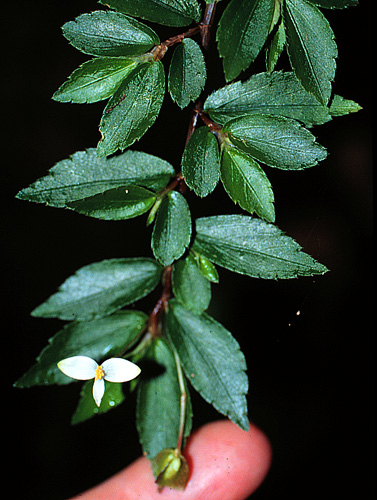
Curtis’s Botanical Magazine, v. 73 = ser. 3, v. 3, 1847 B. foliosa var. miniata as SYN. B. fuchsioides A most lovely new Begonia, detected by Mr. Purdie on the Ocana mountains of New Grenada, during his mission for the Royal Garden of Kew. It is easily propagated by cuttings, grows rapidly, bears small but copious foliage, and is a plant to which he particularly requested our attention, on account of the copious, elegant, drooping, red flowers, at first sight resembling those of a Fuchsia; and because it is much eaten to allay thirst by the Arrieros (mule-drivers) of the country. He also observes that the globular buds (meaning, probably, the buds of the fertile blossoms, which are globular) contain a fluid, which, together with the acid of the flowers, proves highly grateful in the dry season and where there are no rivers. It has bloomed during the autumn months with Mr. Veitch of Exeter, and he has at this time (December 18th) one plant three feet high loaded with the richly-colored flowers. It has been three months in bloom, and has abundance of buds yet to expand. Our plants are now, at mid-winter, beginning to flower. It is singular that, as far as they have yet blossomed, the plants have proved only male-flowered, except the tall one of Mr. Veitch, which has one cluster of female flowers at the top, and of which two are represented at fig. 2. Description: Stem erect, two to three feet high, terete, succulent, glabrous, slightly tinged with red. Leaves copious, distichous, alternate, rather small, about an inch and a half long, dark full green, obliquely oblong-ovate, slightly falcate, acute, serrated, glabrous, the margins are obscurely ciliated, often tinged with red. Stipules oblong, obtuse, colored. Flowers on dichotomously branched, pendent panicle, dioecious, rarely monoecious; all of a rich deep scarlet color. Pedicels bracteated; bracts Ianceolate, acuminate, opposite. Male flowers: sepals four, almost closed over the stamens; two ovate, large an boat-shaped, thick and fleshy, opposite and external; the other two smaller, oblong or approaching to obovate, slightly concave, of a thinner, almost membranaceous texture: column of stamens forming an ovate mass. Female flowers: Sepals five, rarely spreading, oval, nearly equal, concave. Stigmas six, erecto-patent, subulate, waved. Ovary of young fruit white, broadly obovate, triangular, the angles winged; two wings very short and one long, divergent; all red, and decurrent, so as to form a triangular pedicel.; The Garden, v. 36 1889 WINTER-FLOWERING BEGONIAS. In common with the tuberous-rooted section of Begonias that flower during the summer months, those that bloom throughout the autumn and winter have within the last few years become far more popular than hitherto, and some of our most prominent hybridists have devoted their attention to the production of new varieties. Among the older winter-flowering Begonias may be mentioned several of the original species and hybrids raised therefrom, most of which are of a shrubby character, while recently the curious peltate leaved B. socotrana and some of the tuberous-rooted class have been successfully employed in the production of the newer hybrids. Of varieties not springing from either of these two just mentioned and of original species valuable for their winter blooming qualities may be especially mentioned. B. foliosa var. miniata as SYN B. fuchsioides - One of the very finest of all shrubby Begonias, is seen at its best when employed as a pillar plant in an intermediate structure. In this way it forms quite a column of rich deep green foliage, while the very bright scarlet, coral-like blossoms are freely borne at all seasons of the year.
Pests Diseases
- Classification: Species
- Plant Type: Shrub-like
- Botanical Section: Lepsia
- Origin: America, Colombia
- Originator: (Planchon) L. B. Smith & B. G. Schubert, Caldasia
- Date of Origin: 1946
Begonia Community Hub
Share a Growing Update
Loading community updates...