


B. fimbristipula
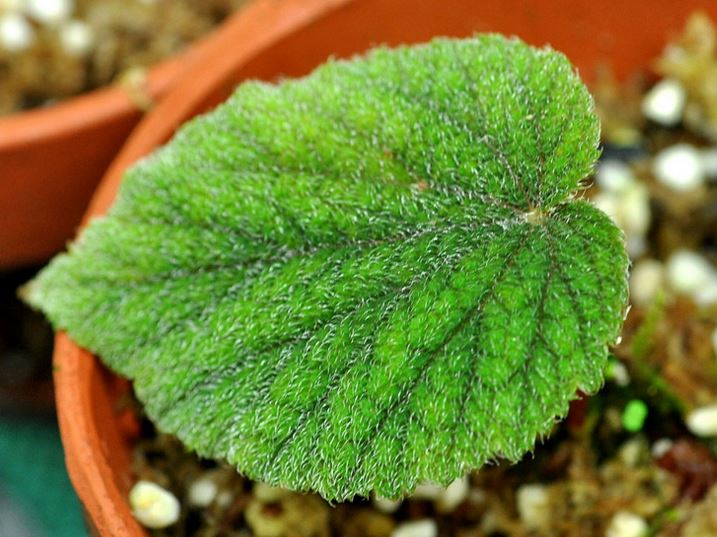
Curtis’s Botanical Magazine, v. 113 = ser. 3, v. 43, 1887 B. fimbristipula as Syn: cyclophylla. I have advanced this as a new species with much hesitation, because it was sent by Mr. Ford from the Hongkong Botanical Gardens under the name of B. fimbristipula, Hance (in Lond. Journ. Bot. 1883, p. 202), and because it agrees with the character of that plant in so many particulars that it appeared to me possible that it might be a gigantic form of it, with characters acquired under cultivation. On referring, however, to the Kew Herbarium, I find authentically named specimens of B. fimbristipula from Lofaushan (on the coast opposite to Hongkong) which show it to be a diminutive very slender little species, two to three inches high, with an ovate cordate acuminate sharply doubly-toothed leaf of a deep red purple color, and a one or two-flowered scape. The Lofaushan specimens agree very well with Hance's description, except that I do not find the under surface of the leaf to be lepidote, and that the outer male sepals are orbicular rather than oblong, and that the petiole is sometimes longer than the limb of the leaf. Specimens from Tingushan, on the Canton river, also in the Kew Herbarium, and cited as B. fimbristipula by Hance, are many times larger than the above, with a branched cyme as in B. cyclophylla, but the leaves are of the same form and toothing as fimbristipula. Another difficulty is to determine the section of the huge genus to which this species should be referred. It agrees with none in De Candolle's monograph (Prodr. v. xv. pars. i.). According to his Clavis (p. 403) it should fall into Dysmorphia, with two Peninsular Indian species (B. crenata, Dryandr., and B. canarana, Miq.); but these are described as having anthers dehiscing by pores, four to five sepals in the female flower, connate styles, and inflated capsules. Hance supposes his B. fimbristipula (with which this must go) to be most nearly allied to B. parvuliflora, A. D C., which belongs to the section Parvibegonia, and which should have four to five segments in the female flower, and deciduous styles. According to the grouping of the species sketched out in the ‘Genera Plantarum,’ it falls into the fourth series, and would be included in an enlarged view of Platycentrum (inclusive of Knesebeckia). Its nearest ally in floral structure appears to me to be B. sinensis of A. DC., a caulescent species of very different habit, referred by A. de Candolle to Knesebeckia. A. similar species to B. fimbristipula, of which leaves are preserved in the Kew Herbarium, is extensively used by the Chinese as a drug. The leaves are of a brilliant red purple color. Our specimens were raised from tubers sent by Mr. Ford from the Hongkong Botanical Gardens in 1885, and flowered in April 1886. The flowers are sweet-scented, like roses. Description: Root tuberous. Leaf solitary, attaining six inches in breadth, orbicular-cordate with overlapping basal lobes, obtuse or subacute, palmately seven- to nine-nerved, obscurely denticulate, sparsely hirtellous on the upper surface and on the nerves beneath, deep green above, pale inclining to red beneath; petiole rather stout, shorter than the blade, sparsely hirsute; stipules oblong, fimbriately ciliate. Scape six inches high, slender, glabrous, bearing a trichotomous cyme of rose-colored and -scented flowers of both sexes; bracts at the fork like the stipules. Male Flowers: one to one and a quarter of an inch in diameter. Sepals two, orbicular. Petals two, obovate. Anthers small in a globose head on a short slender column, obovate, tip rounded. Female Flowers: smaller than the males. Sepals two, semicircular. Petal one very much smaller, oblong, concave. Styles three, each two-fid, with a twisted papillose band, persistent in fruit. Capsule triangular-deltoid in outline, larger wing trigonous, upper margin horizontal, smaller linear; placenta bipartate, all surfaces seed bearing. - J. D. H.
- Classification: Species
- Plant Type: Tuberous - deciduous
- Botanical Section: Diploclinium
- Origin: Asia, China
- Originator: Hance, J. Bot.
- Date of Origin: 1883
Begonia Community Hub
Share a Growing Update
Loading community updates...