


B. eminii
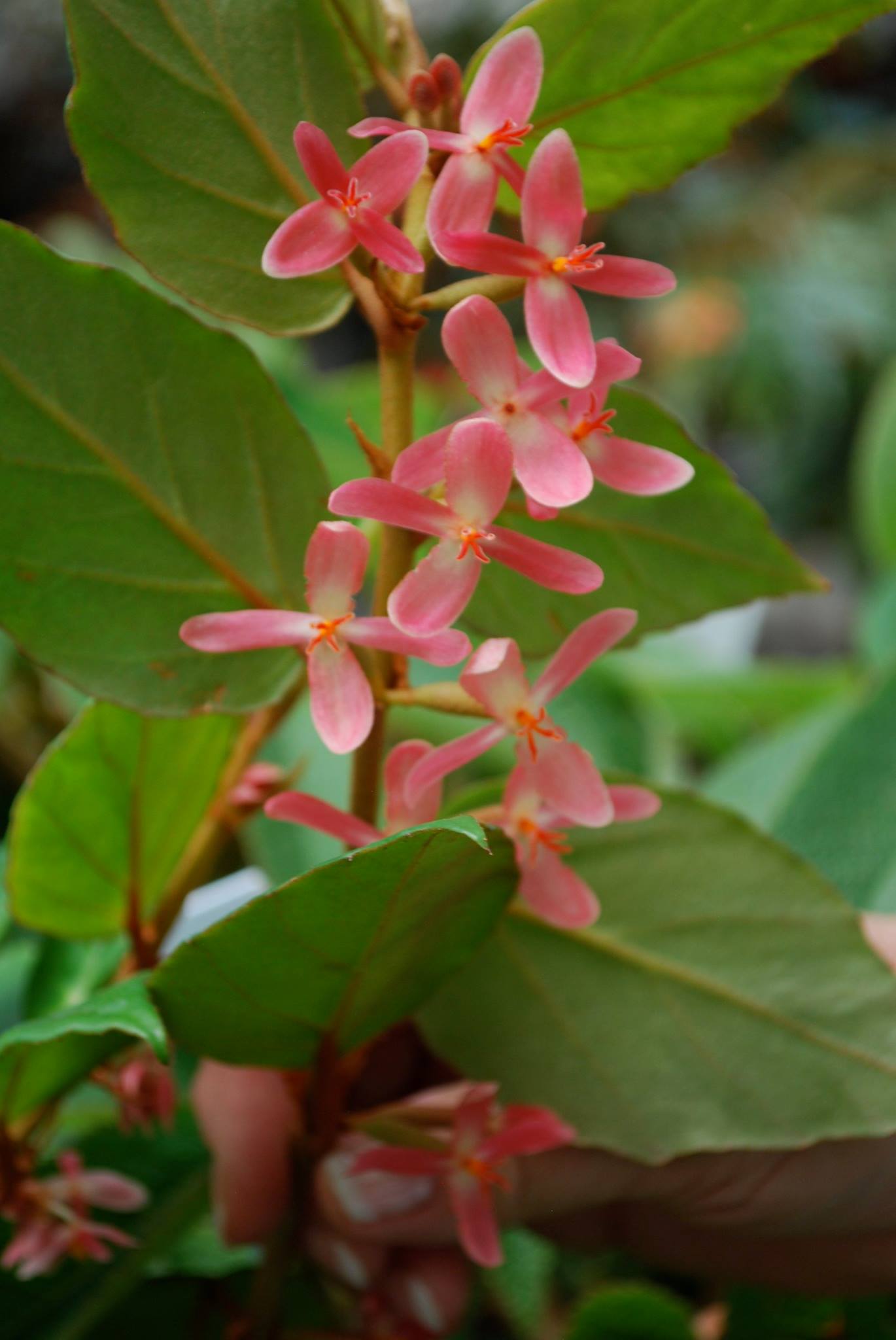
B. eminii Warburg by Mildred L. Thompson B. eminii Warburg was discovered in Victoria Nyanza, Africa. The name was first listed by Otto Warburg in "Begoniaceae," Die Naturlichen Pflanzenfamilien III, 6A (pg. 141), which was published in Leipzig in 1894. The first description was by Otto Warburg in Die Pflanzenwelt Ost-Afrikas und der Nachbargebiete (pg. 282), which was published in Berlin in 1895. For botanical classification B. eminii is placed in the genus Begonia in the section Tetraphila (Fusibegonia Warburg). About thirty-nine African species have been placed in this section. Characteristically they are epiphytic and climbing with roots often produced at the nodes. Leaves have a pinnate venation. The inflorescences are few-flowered. The male flowers have four tepals and the female flowers have four tepals with the two inner ones narrower. The wingless ovaries are cylindrical-fusiform. Some of the species placed in this section, that are in cultivation today, are as follows: B. cavallyensis, B. jussiaeicarpa, B. mannii, B. molleri, B. polygonoides, and B. squamulosa. Presently the horticultural classification of B. eminii Warburg is: thick stemmed, bare-leaved, medium-leaved (generally 4" - 6" at maturity), according to The Thompson Begonia Guide. Ten years ago, a species collected in Cameroon was identified erroneously as B. eminii Warburg. Seeds of this species were distributed with this name. Many growers are still growing this African species labeled as B. eminii. For a time, this species was also identified as B. rubro-marginata Gilg. Recently Dr. J. J. F. E. de Wilde, who works with the Plant Taxonomy Department of Wageningen University, identified this species as B. cavallyensis Chevalier. In July 1976, our branch launched a species survey project. Ed and I received seeds of the true B. eminii from Dr. Doorenbos, of Wageningen University, in July 1975. Six of the resulting young plants were given to members to study and grow in their particular growing environments. A biographic sketch was done on Otto Warburg, the author of the original citation of B. eminii. The original citation' was translated from the Latin. A later description by R. Wilczek, of the Belgium National Botanic Gardens, was translated from the French. We are most grateful to Dr. Doorenbos for the seeds of B. eminii and the background information that he has sent to us. We are grateful to Dr. Fred A. Barkley for editing our translations. Begonia eminii Warb. in Engler, Pflanzenw. Ost-Afr. C; 282 (1895) - Plate 3. Epiphyte; monoecious, indumentum formed of modified scaly dentate- Iaciniate hairs; stem creeping or sprawling, .5-4 (sic) meters long, branched, radicant at the nodes, red, The Segonian plump to sublingeous, tomentose to glabrous. Leaves: lance-shaped stipules from 1.2-3.5 centimeters long, puberulent on the outside, more or less persistent, petiole from 2.5-13 centimeters long, slender, bright red, hairy to hairless; limb is of an oblique heart-shaped oval, asymmetrical, cordate at the base tapering to a sharp point at the apex, from 8-21 cm long and from 5-11 cm wide, denticulate to sinuate, like thin paper, two colors: bright and green above, red-brown underneath when in bloom; smooth above, hairy below, especially on the veins, lateral veins in pairs of 5 to 7, projecting and red on the lower surface. Inflorescence: axillary and unisexual; male has 5-9 flowers with main stalk from 4-9 mm long, slender, puberulent, provided with lance-ovate bracts at the top reaching a length of 2 mm; caducous; the pistillate has three flowers with peduncle from 2-8 mm long. Flowers: white, pink to red; 4 unequal tepals, the external tepals are puberulent on the outside. Staminate flower: has pedicels from 5-10 mm long, slender, puberulent; external tepals are ovate-elliptical, reaching 8-11 mm in length, 3-6 mm wide, puberulent; the inner tepals are elliptical, reaching 5 mm long and 2 mm wide, glabrous; androecium is loose, unilateral, from 8-13 filaments found in a column at the base and partly free. They are about 0.3 mm long; anthers are oblong, rounded at the top, reaching 1.25 mm in length with longitudinal dehiscence. Pistillate flower; pedicel reaching 8 mm in length; tepals appear to be those of the male flowers but much smaller; ovary cylindric spindle-shaped from 1.5-2 cm long and 0.2 cm in diameter; lively red when in bloom tomentose to puberulent, and has 3 locules; styles 2 or sometimes 3, lightly fused at the base and forked; the stigma has spiraled surfaces on the upper part of the pistils; placentas complete central. Fruits: the pedicels attaining 12 mm in length; fusiform-cylindrical, 2-4.5 cm long and about 0.5 cm wide; dry and indehiscent, red in blossom and sparsely puberulent. Usage: fruits and leaves are edible.
Pests Diseases
- Classification: Species
- Plant Type: Thick Stem
- Botanical Section: Tetraphila
- Origin: Africa, Central & East Africa
- Originator: Warb.
- Date of Origin: 1894
Begonia Community Hub
Share a Growing Update
Loading community updates...