


B. dichroa
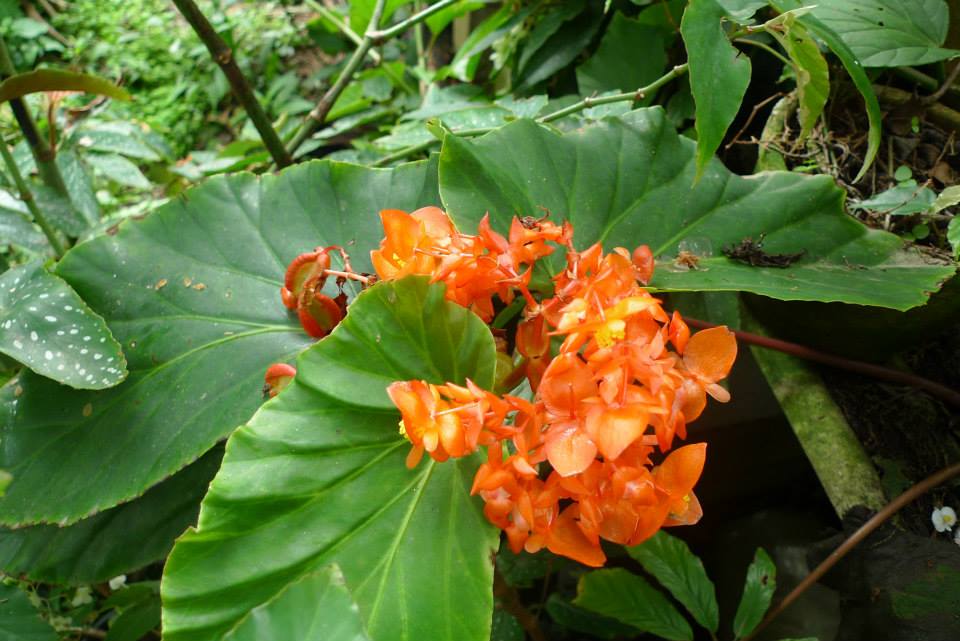
Curtis’s Botanical Magazine, v. 138 = ser. 4, v. 8, 1912 B dichroa: The interesting Begonia which forms the subject of our illustration was obtained for the Kew collection in 1907 from Messrs. Haage & Schmidt, Erfurt. It occupies a somewhat isolated place within the section Knesebeckia, yet while this is its most satisfactory systematic position as the species of this extensive genus are at present classified, it bears a striking resemblance to B. maculata, Raddi, a species which belongs, however, to the section Gaerdtia, in which the two segments of the placenta bear ovules on their outer surfaces only. The most natural explanation of this peculiar combination of characters that can be suggested is that B. dichroa may be a hybrid between two species belonging to different sections. Yet in the present instance this explanation is perhaps not the true one, because B. dichroa has matured seeds at Kew, and the resulting plants have proved to be exactly like the parent one. It is, however, just possible that too great stress has been laid upon the character afforded by the circumstance that the segments of the placenta bear ovules on one side only, or on both surfaces. B. dichroa is a species that requires tropical conditions. It has large leaves and is of a somewhat, lax habit; for a Begonia its growth is slow. The flowers, which are produced in spring, are remarkable for their shining orange-scarlet color, a tint unlike that of all of the other cultivated species included in the group known in gardens as shrubby Begonias. Description: Herb, tall, with minute scattered beaded glandular hairs on the young shoots and inflorescence, otherwise glabrous. Leaves in young plants rhomboid-elliptic, semi cordate, acuminate, 4-5 in. long, 2 in. wide or rather wider, blotched with white; in full-grown plants ovate-oblong, sharply acuminate, base semi-cordate but very oblique, 8-nerved with the lowest pair small and inconspicuous, higher up with the nerves again pinnately 3-5-nerved on each side, 9-12 inches long, 4-5½ in. wide, margin slightly undulate; deep green above, somewhat polished, pale beneath; petiole ¾-2 in. long; stipules ovate, sharply acuminate, 1 lin. long, 7 lin. wide. Peduncle 1¼-2½ in. long. Dichasium many-flowered, the male flowers terminal, the female axillary. Bracts cymbiform, ovate when outspread, obtuse, 5-7 lin. long, 4-5 lin. wide, pink like the rachis. Male flowers pedicelled, about 10 in. long. Perianth segments 4, pink, the outer pair wide obovate, obtuse, nearly 1 in. long, ¾ in. wide, the inner pair oblanceolate, rounded, ½ in. long, 2-2 ½ in. wide. Stamens inserted on convex raised receptacle; filaments short; anthers obovoid-oblong, very short, their cells convergent towards the base. Female flowers sessile or slightly pedicelled. Perianth segments 5, pink, the two-outermost wide obovate, obtuse, 7 lin. long, about 5 lin. wide, the innermost oblong, rounded, 3 ¼-4 lin. long, barely 2 lin. wide, the remaining two intermediate in size and form. Ovary 3-celled, about 8 lin. long, at first white, ultimately with a purplish tinge; wings 3-3½ lin. wide; placentas 2-partite, their lamellae bearing ovules on both faces. Styles shortly united at the base, under 3 lin. long, bifurcate, their arms very short and helicoidly twisted, the stigmatic papillae extending downwards beyond the point of bifurcation.
- Classification: Species
- Plant Type: Cane-like
- Botanical Section: Gaerdtia
- Origin: America, Brazil
- Originator: T. A. Sprague, Bull. Misc. Inform.
- Date of Origin: 1906
Begonia Community Hub
Share a Growing Update
Loading community updates...