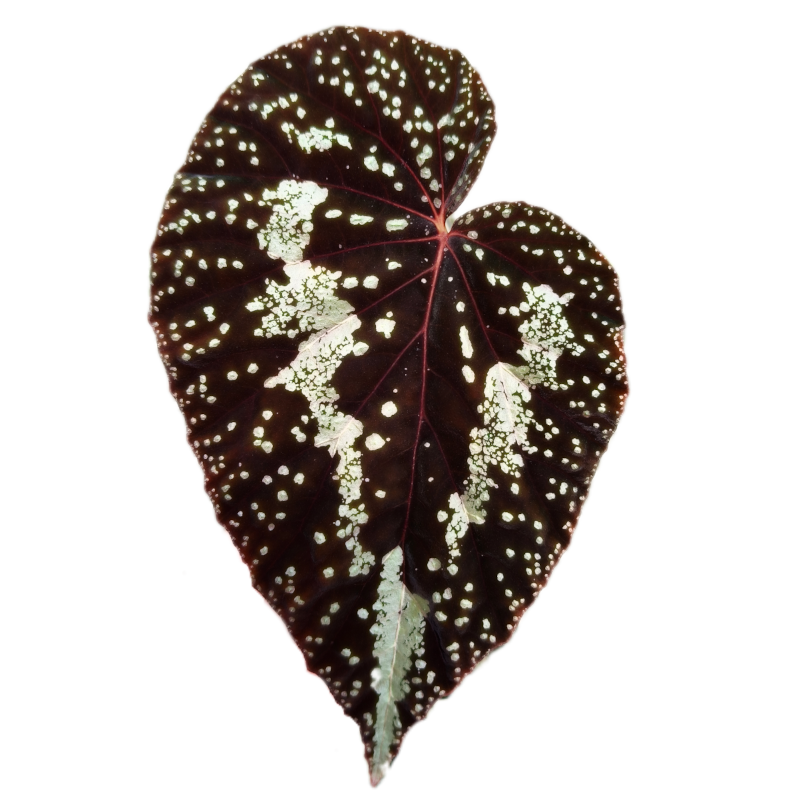

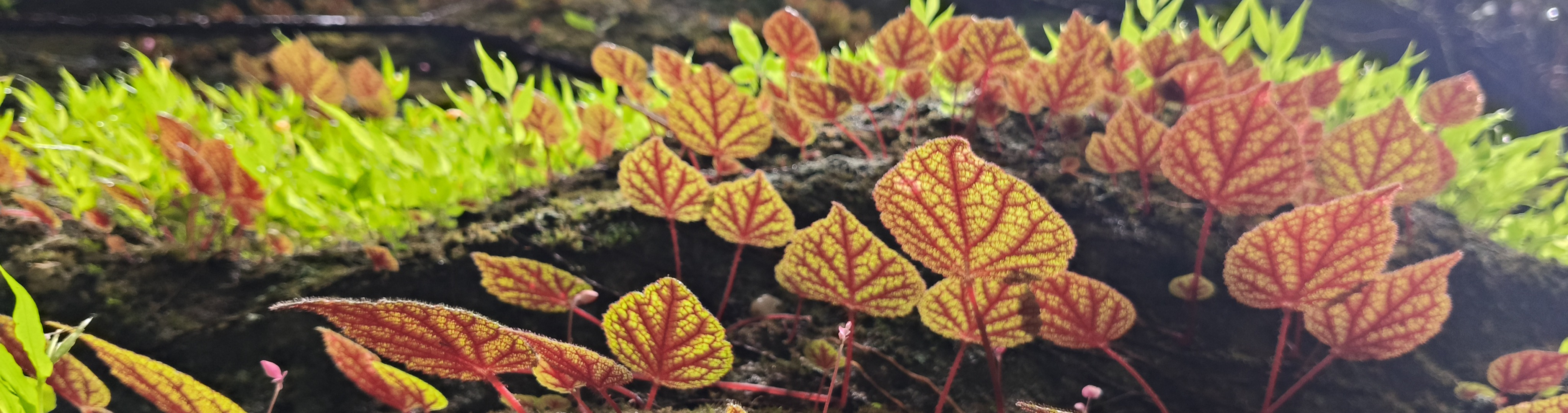
B. cyathophora
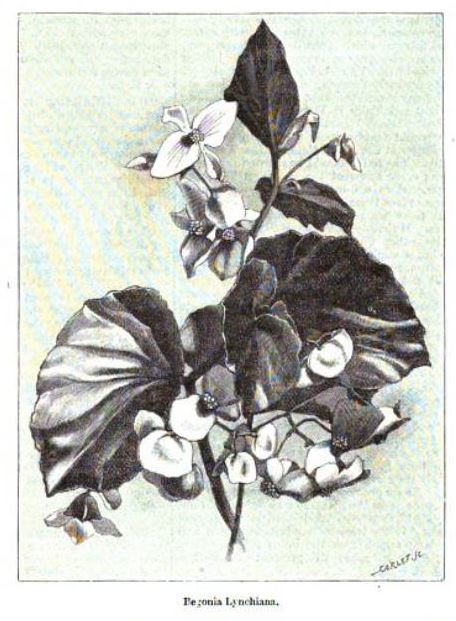
Curtis's botanical magazine, v. 110 = ser. 3, v. 40, 1884 B cyathophora as SYN. B. lyncheana: A very noble species of a genus the ornamental species of which, numerous as they are, both Indian and American, are far from being exhausted for garden purposes. It belongs to the. American set of the genus, but does not fit well into any of the sixty-one sections as defined by A. De Candolle in his elaborate monograph of the genus published in the fifteenth volume of the Prodromus. It comes near to Gireoudia, from which it differs in the multifid styles, in the free spreading filaments, and in the anthers not being in a compressed one-sided mass. Upon the whole, I believe its affinity is with the species of the section Begoniastrum, A. DC. (Begonia proper of Klotzsch), notwithstanding the few perianth lobes of the female flower, and the much-divided styles; and in this case its near ally is B. nitida, Ait. (see Tab. 4046), with which it precisely accords in habit. The styles are in fact nearly those of section Husyia, A. DC., but are less deeply divided (see B. octopetala, t. 3559, B. rubricaulis, t. 4131, B. Clarkei, t. 5675, and B. rosaeflora, t. 5680). B. Lyncheana has been known under the name of B. Roezli, apparently given in ignorance of there being a previously published Begonia of that name (see Regel's Gartenflora, t. 871). It is a Mexican species, introduced by seed from Roezl, according to a note published in the '' Gardener's Chronicle," vol. xi. part 1, p. 566 (1879), by M. Benary, of Erfurt., who raised it for Lynch, to whom I am indebted for the specimen here figured, received it from the Rev. Mr. Law, of Little Shelford, Cambridgeshire, and I gladly dedicate it to the indefatigable superintendent of the Cambridge Botanical Garden, who has raised that establishment to a high degree of scientific value and of beauty. It flowers in early winter and for many succeeding months. Description. Quite glabrous, monoecious. Rootstock stout, somewhat tuberous. Stem two to three feet high, erect, branched, a thick as the little finger, pale bright green, smooth. Leaves alternate, shortly petioled, five to eight inches long, very obliquely orbicular-oblong or subreniform, obscurely lobed, base deeply cordate with rounded lobes, margin erose and ciliolate, nerves ten to twelve, radiating from the petiole, bright green above, paler beneath with reddish nerves; petiole shorter than the blade, as thick as a goose-quill; stipules an inch long, sheathing, membranous, very deciduous. Peduncles axillary, stout, six to ten inches long, as thick as a swan's quill. Panicle corymbiform, six to eight inches in diameter, many-flowered, top flat, when young enclosed in an involucriform cup formed of two connate membranous bracts; flowers bright scarlet; pedicels half an inch long, slender. Male flowers: most abundant, appearing first. Perianth segments two, three-quarters of an inch in diameter, rounded, concave. Stamens many, in a hemispheric cluster; filaments free, shorter than the shortly oblong obtuse anthers. Female flowers: Perianth segments two to four, much smaller than in the male, concave. Ovary three to four-winged; wings broad, rounded, dorsal produced very obtuse; placentas two-partite, segments ovuIiferous on both faces, styles three, deeply divided, with capitate stigmas. - J. D. H.; Flora of Peru. by J. Francis Macbride. Chicago, Ill. Field Museum of Natural History, [1941] v. 13: pt. 4: no.1 (1941): Page 181- 202 http://www.biodiversitylibrary.org/item/19800 Succulent herb, 6- 10 dm. high, glabrous. Stem subsimple, strict. Leaves obliquely broad-ovate, palminerved, short-acuminate, cordate at base, 15-22 cm. long, to 16 cm. wide, shallowly angularlobate, crenate-serrulate, pale green, petioles 5- 10 cm. long, stipules deciduous, very broadly elliptic or obovate, distinct but simulating a continuous cyathium, 2-4 cm. long, entire, thin. Peduncle elongate, with ~ large bracts at summit, cyme dichotomous, many-flowered. Upper bracts deciduous, broadly ovate. Pedicels capillary, 12- 24 mm. long. Staminate tepals 2, broadly ovate, cordate, obtuse, 9- 11 mm. long. Stamens on a low torus, filaments short, anthers oblong, the connective produced and dilated. Pistillate tepals 2. Styles 3, short, 2-parted, placentae bilamellate. Capsule 8 mm. long, the largest wing oblong, 2 cm. wide, the other 2 very small. F. M. Neg. 20861 (subciliata 8518).
Pests Diseases
- Classification: Species
- Plant Type: Shrub-like
- Botanical Section: Cyathocnemis
- Origin: America, Bolivia; Peru
- Originator: Poeppig & Endlicher, Nov. Gen. Sp. Pl.
- Date of Origin: 1835
Begonia Community Hub
Share a Growing Update
Loading community updates...