


B. coriacea
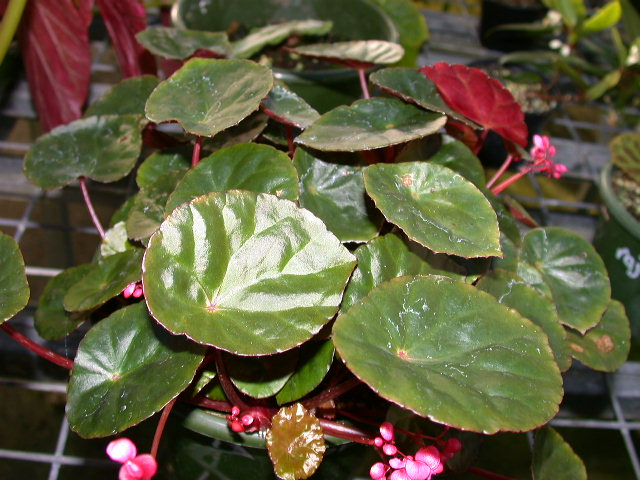
Curtis's botanical magazine, v. 78 = ser. 3, v. 8, 1852 B. coriacea as SYN hernandiaefolia: Received at the Royal Gardens of Kew from seeds sent from Veraguas by Mr. Seemann. I have failed in finding the description of any species that will tally with it. Much of the character, indeed, of B. peltata, Haskrl., (as given in the fifth volume of Walpers' Repertorium, p. 766) well corresponds with this but that is placed in a group called ''Repentes," is said to be ''caulescent," and is a Java plant. Further, the same species is described in the second volume of the Repertorium, p. 210, as having the leaves tomentose: whereas our plant is not caulescent, nor creeping, and has glabrous foliage. It is indeed a most lovely species, with singularly shaped, very thick, concave and peltate leaves, deep blood-color beneath, and the copious petioles, peduncles, and flowers of a full rose-red. It flowers readily in the stove during the summer months. Description: Stemless. From the top of the root spring numerous bright red terete petioles, stipules at the base, two to four inches, or rather more long which are inserted underneath, and at nearly an inch distance from the base of the very thick, between fleshy and coriaceous subrotundo-ovate acuminated, rather oblique, concave leaves: indistinctly glanduloso-serrated at the margin, quite glabrous, dark green above, with a pale spot at the insertion of the petiole, from which a few indistinct nerves radiate, deep blood-red beneath, with the nerves slightly prominent. Scapes radical, longer than the petiole, about as thick and of the same color as it, bearing a dichotomous corymb of drooping, deep rose-red flowers; at the setting-on of the branches a pair of opposite small stipules are present. Each fork generally bears one male and one female flower. Male flower of four spreading sepals, two (opposite) larger and orbicular, the two smaller oblong-spathulate. Stamens a small head of many nearly sessile oval anthers. Female flower of three sepals, two large, and a small, oblong-spathulate one. The fruit (nearly mature) is bright red, triangular, obovate, with a narrow, rounded wing at two of the angles, and a much broader rounded one at the third angle. Style short. Stigma sinuato-lobate.
Pests Diseases
- Classification: Species
- Plant Type: Rhizomatous
- Botanical Section: Jackia
- Origin: Asia, Indonesia
- Originator: Hasskarl, Cat. Hort. Bogor. Alt.
- Date of Origin: 1844
Begonia Community Hub
Share a Growing Update
Loading community updates...