
B. ‘Lapeyrousii’
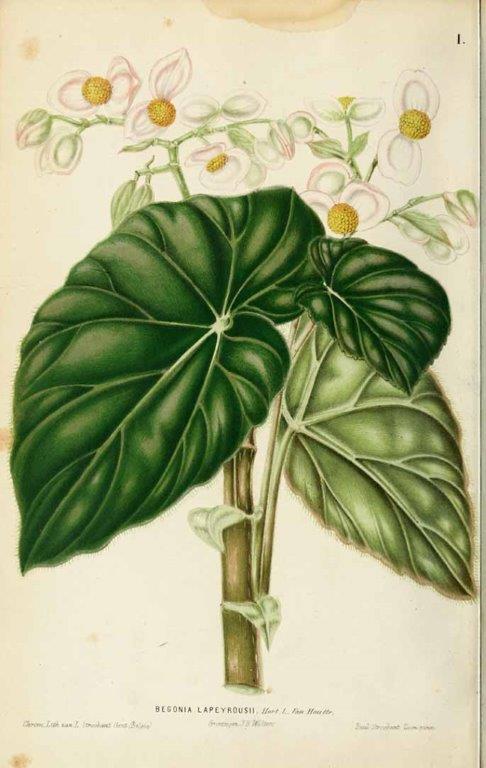
The [Begonia] depicted on out 1st Plate under the name B. Lapeyrousii is actually a hybrid obtained by crossing B. hydrocotylifolia with B. incarnata, in the sense that the former provided the ova, the latter the pollen. Scientifically, it should therefore be called B. hydrocotylifolia incarnata, since botanists have adopted the principle that the specific name of every variety obtained by hybridization shall consist of two words, the first of which recalls the name of the parent plant and the second that of the father plat.
The name B. Lapeyrousii was given to our plant by the well-known breeder L. Van Houtte of Ghent, in honor of Mr. De La Peyrouse, from whom he received one of the individuals, bred by the latter himself through crossbreeding, as a gift in 1853. The specimen after which our plate was drawn originated from the nursery of Mr. J.B. Greonewegen here, and was bred from others, delivered by Van Houtte himself to Mr. Glijm of Utrecht.;
B. Lapeyrousii belongs to the shrubby Begonias, grows to 6 to 7 palms high, has a strong trunk and fairy large, obliquely heart-shaped-ovate, bright green, glossy leaves. On the underside they are paler than on the upper side, and furthermore finely ciliate along their soft pinkish-red margin, yet otherwise hairless. The long leaf stalks have neither collars nor bristles. The soft pinkish-red glossy flowers are packed closely together and seated by their distinct (short) stalks on a common stem, which approaches or exceeds the stem leaves in length. Each flower has no more than 2 sepals. No petals are found on them. The bright green of the leaves and the satin-soft red of the numerous flowers make B. Lapeyrousii a true ornament for flower tables. Also referred to as Begonia x Lapeyrousei
- Classification: Cultivar
- Plant Type: Shrub-like
- Origin: Europe, Belgium
- Originator: L. Van Houtte
- Date of Origin: 1853
Begonia Community Hub
Share a Growing Update
Loading community updates...