


B. ‘Grandis’
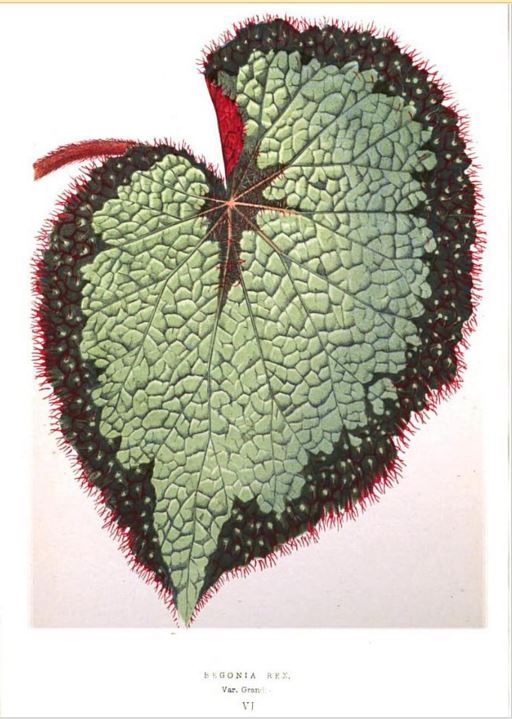
A superb hothouse plant, currently very fashionable, and with many comparable relatives. This beautiful variety was obtained from seed in 1858 by Messrs. Rollisson, father and son, of Tooting, England
It is a herbaceous plant 30 to 35 centimeters tall, forming a large clump. Its heart-shaped leaves with unequal sides average 25 centimeters long by 20 centimeters wide. Their upper surface is olive-green tending towards brown, with a broad, irregularly bordered white area that divides the green hue into two compartments, the outer compartment forming a narrow band along the leaf edge. The underside is uniformly carmine-red. The flowers are large and carmine-colored.
Like the vast majority of its relatives, and especially Like the Begonia rex from which it originates, this variety belongs in the heated greenhouse, where it remains year-round. In summer, it needs a temperature of 20 to 27° Celsius; in winter, it is content with 18 to 20°C.
The best compost for it consists of: one part garden soil, two parts coarsely sifted ericaceous compost, and one part leaf mold, all well mixed. Repot in March, and water generously in summer, simply misting the soil lightly in winter. The pots must be carefully drained with shards of pottery, to a depth of two or three centimeters.
Propagation is done here by means of leaves cut into seven or eight pieces, more or less, depending on their size These cuttings are planted upright or at an angle, even almost flat, in well-drained pots or containers filled to within two centimeters of the rim with the compost described above, the remainder being covered with a layer of pure sand, kept very moist. Once planted, they are covered with a cloche shaded by a sheet of paper, and placed on a bed of tanbark, or better yet, sand, heated to 26 or 27°C. In just a few days, if the humidity and temperature have been maintained at the proper level, roots will form at the base of these cuttings, and soon buds and leaves will appear. As soon as the leaves have developed, the plants are removed and placed in small pots, which are then buried in the tanbark, and they are gradually acclimated to air and light. These cuttings generally reproduce the variety identically.
It is different with seeds, when they can be harvested from adult plants. These almost always give rise to new varieties, which is a great advantage for the amateur. Care should therefore be taken, when the plants are in flower, to ensure fruiting by artificial pollination, and to harvest the seeds when they are ripe. Sowing is done in well-drained trays, and on heath soil, moreover under the same conditions of heat and humidity as the planting of cuttings.
- Classification: Cultivar
- Plant Type: Rex Cultorum
- Origin: Europe, UK
- Originator: Rollisson
- Date of Origin: 1858
Begonia Community Hub
Share a Growing Update
Loading community updates...